
4 Best Railroad Work Boots for Track Crews
The ARIAT Sierra Wide Electrical Work Boot is our top pick for most buyers seeking the best railroad work boots. Its wide fit gives many workers more room during long shifts, while the electrical-work design suits demanding job sites. This boot makes the most sense for rail crews who need support, protection, and a roomier toe area without moving into a heavy logger boot.
This guide is for railroad workers, track maintenance crews, and anyone buying footwear for rough outdoor work. Focus on accurate sizing, leather construction, toe protection, electrical hazard ratings, and outsole traction. A comfortable fit matters just as much as protective features, since tight boots can become painful during 10-hour shifts. The four picks below are ranked with clear reasons and honest drawbacks for each, so you can compare protection, comfort, and job-site practicality before buying.
Quick Comparison
| # | Product | Best For | Price | |
|---|---|---|---|---|
| 1 | ARIAT Sierra Wide Electrical Work Boot | Wide-Fit Electrical Trade Workers | ~$180 | View → |
| 2 | EVER BOOTS Tank Men's Work Boots | Budget-Friendly Daily Jobsite Wear | ~$65 | View → |
| 3 | Cat Threshold Steel Toe Work Boot | Heavy-Duty Industrial Jobsite Protection | ~$90 | View → |
| 4 | NORTIV 8 Steel Toe Work Boots | Outdoor Work In Wet Conditions | ~$49 | View → |
4 Railroad Boots Worth Considering
These picks are ranked by protection, comfort, traction, and value, counting down to the strongest overall choice.
4. NORTIV 8 Steel Toe Work Boots

Best for: Construction and warehouse work
The NORTIV 8 is a men’s steel toe work boot for construction, warehouse, landscaping, welding, and similar jobs. This listed option comes in size 12 with brown, black, and tan styling. Its steel toe and rubber toe cap meet ASTM 2413-18, adding protection against falling objects and compression. The upper uses a static waterproof design rated for up to four hours, which suits wet job sites but does not make the boots suited for all-day immersion.
The lugged rubber outsole meets ASTM F3445-13 for slip resistance and footing on uneven surfaces. Inside, a mesh-covered EVA insole adds cushioning, while the lightweight EVA midsole helps reduce fatigue during long periods of standing or walking. Around $49, these boots offer useful job-site protection without moving into a higher price range. The main appeal is the combination of safety features, water resistance, and cushioning in one work boot. Still, buyers should treat the four-hour waterproof rating as a limit, not a guarantee for heavy rain or standing water.
Pros
- Steel toe and rubber cap meet ASTM 2413-18 for impact and compression protection.
- Lugged rubber outsole meets ASTM F3445-13 for improved traction.
- Mesh-covered EVA insole and EVA midsole support extended wear.
Cons
- Waterproofing lasts up to four hours, so prolonged exposure can still lead to wet feet.
- Steel-toe construction may feel heavier and less flexible than casual work shoes.
3. Cat Threshold Steel Toe Work Boot

Best for: Wet job sites and warehouse shifts
The Cat Threshold is a men’s work boot in a Real Brown finish, shown here in US size 11. Its main protective feature is a steel toe, which adds a barrier at the front of the foot when dropped tools or other impacts are possible. A waterproof membrane helps keep outside moisture from reaching your socks, while the leather upper gives the boot a work-ready exterior. At around $90, it falls into the lower-priced range for a waterproof safety boot, though prices can change.
The outsole uses a slip-resistant compound, making this pair better suited to wet floors, muddy paths, and general job-site walking than a casual leather boot. The upper is described as breathable, which may help reduce heat during long shifts, but it will not feel cool in every setting. A steel toe can also feel less flexible than a soft-toe design, especially when crouching or climbing. The listed size is US 11, so shoppers should confirm available options. No width details are provided, which matters for buyers with broad feet.
Pros
- Steel toe adds front-foot protection for work hazards.
- Waterproof membrane helps block rain and surface moisture.
- Slip-resistant outsole suits wet floors and outdoor paths.
Cons
- Steel toe may add weight and reduce flex compared with soft-toe boots.
- No width information is listed, so fit may be harder to judge.
2. EVER BOOTS Tank Men’s Work Boots
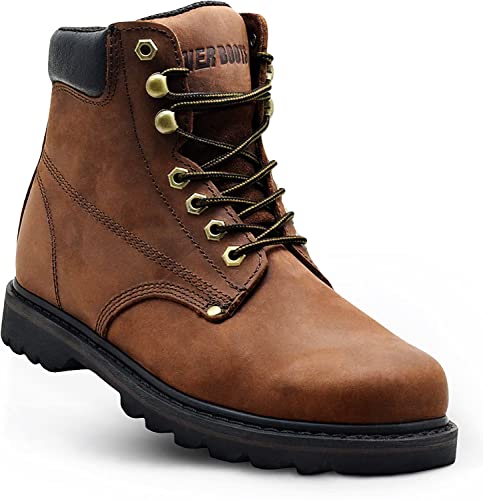
Best for: construction crews needing affordable pull-ons
The EVER BOOTS Tank is a dark-brown men’s work boot with a soft toe, tall ankle profile, and rubber outsole. The listed size is 6 D(M), with a standard medium width. Its leather construction is described as oil full grain, while the feature details also call the upper nubuck, so buyers should confirm the material before ordering. The soft toe keeps the boot lighter than a safety-toe model, but it does not provide the same protection from falling objects.
A padded collar, reinforced stitching, and arch support add useful structure for construction, landscaping, contracting, and other physical jobs. The removable insoles leave room for custom orthotics, which helps buyers who need specific foot support. The wide rubber sole should provide a stable base on common work surfaces. Sizing is intended to match major men’s work-boot brands. Women can use the listed conversion, such as a women’s size 9 matching an Ever Boots size 7. At around $65, the Tank targets shoppers who want a leather work boot without paying premium-brand prices.
Pros
- Removable insoles allow room for custom orthotics.
- Padded collars and reinforced stitching add comfort and durability.
- Wide rubber soles provide a stable base for physical work.
Cons
- The soft toe lacks safety-toe protection for impact or compression hazards.
- Material descriptions conflict, listing both full-grain leather and nubuck, so confirm the upper before buying.
1. ARIAT Sierra Wide Electrical Work Boot

Best for: Railroad, welding, and jobsite work
The ARIAT Sierra is a 10-inch leather work boot built for demanding conditions. This Aged Bark version uses a full-grain leather upper, a square toe, and Goodyear welt construction. A six-row stitch pattern adds a traditional western look without changing its work-focused design. The listed size is 11 US, and the price typically sits around $180.
Its ATS support system is designed to improve foot stability during long shifts, while the 90-degree heel helps keep the foot planted on ladders and hard floors. The Duratread outsole resists oil and slipping, with tread suited to muddy or slick work areas. The leather platform is also described as heat- and abrasion-resistant, which fits welding and railroad tasks. Still, the listing does not provide a specific electrical hazard certification, so buyers should confirm workplace requirements before relying on it for electrical jobs.
Pros
- Full-grain leather and Goodyear welt construction offer a durable work-ready build.
- Oil- and slip-resistant Duratread outsole improves traction on wet or muddy floors.
- ATS support and a 90-degree heel promote stability during long shifts.
Cons
- The listing does not name an electrical safety certification, a key detail for electrical work.
- Full-grain leather and a 10-inch shaft may feel stiff during the break-in period.
Buying Guide
Safety certification should come first when choosing railroad work boots. A proper pair should protect against impact, compression, electrical hazards, and slippery ballast during long shifts.
- Safety toe: Choose steel or composite toes meeting ASTM F2413 impact and compression standards. Composite toes weigh less, while steel usually costs less.
- Traction: Look for oil-resistant, slip-resistant rubber outsoles with deep lugs, around 4 to 6 millimeters. A defined heel helps on ladders and uneven track.
- Electrical protection: Select boots marked with ASTM electrical-hazard protection if your job involves energized equipment. This feature does not replace site lockout procedures.
- Height and support: An 8-inch shaft covers the ankle and helps block ballast. A firm heel counter and shank support can reduce foot movement inside the boot.
- Fit and durability: Leave about ⅜ inch between your longest toe and the front. Full-grain leather usually costs $120 to $250 and needs regular conditioning, while waterproof membranes help in wet conditions but may reduce breathability.
If you cannot have everything, prioritize certified safety protection and reliable traction over waterproofing, lighter weight, or extra insulation.
Frequently Asked Questions
How should railroad work boots fit for long shifts?
Railroad work boots should fit snugly at the heel and midfoot, with room for your toes to spread without touching the cap. Leave about a thumb’s width, roughly 1/2 inch, between your longest toe and the front of the boot. Your heel may lift slightly at first, but it should not slide during stairs or ballast walking.
What safety features matter most in railroad work boots?
The key features are a safety toe, slip-resistant outsole, electrical-hazard protection, and construction that matches your railroad employer’s rules. Many protective-toe models use ASTM F2413 labeling, while an outsole with defined lugs can help on ballast and wet platforms. Check the exact marking, since electrical-hazard protection does not replace safe distance from live power.
Can waterproof railroad boots handle trackside work in all weather?
No, waterproof railroad boots cannot handle every weather condition, especially deep water, flooding, or damaged linings. Choose a sealed upper, gusseted tongue, and treated leather or a waterproof membrane, then dry the boots fully between shifts. Waterproof ratings do not stop sweat, so moisture-wicking socks help during 10- or 12-hour shifts.
Are steel-toe or composite-toe boots better for railroad work?
Composite-toe boots suit workers who want less weight or cold transfer, while steel-toe boots suit those who prefer a thinner, familiar cap. Both can meet the same safety standard when certified. Check ASTM F2413 labeling and leave about 1/2 inch ahead of your longest toe for comfortable movement.
Conclusion
ARIAT Sierra Wide Electrical Work Boot remains the top recommendation for railroad workers who need a roomier fit and footwear made for electrical work. If your priority is wet-weather protection instead, choose a waterproof work boot with sealed construction and a slip-resistant outsole, even if it gives up some width or electrical-focused features. Before ordering, double-check the size chart, electrical-hazard compatibility with your job requirements, the quantity included if buying a pair or replacement item, and the current price. Pay close attention to return rules, too. Railroad duties can involve long shifts, uneven ballast, ladders, and metal surfaces, so fit matters as much as protection. A boot that pinches or feels unstable will not earn its place in your gear.