
6 Best HDD for Security Camera for 24/7 Recording
For most buyers, the Seagate SkyHawk ST4000VXZ16 Surveillance HDD is the best hdd for security camera and the top pick because it is designed for continuous surveillance recording. Its 4TB capacity gives a practical starting point for systems that record around the clock, while its surveillance-focused design fits DVR and NVR use better than a general desktop drive.
This guide is for homeowners, small businesses, and installers choosing storage for wired or network cameras. The key choices are capacity, camera count, recording resolution, and the drive’s ability to handle sustained write activity. Retention goals matter too. Keeping footage for 30 days requires far more space than keeping it for seven. The six picks below are ranked with clear reasons and honest drawbacks for each, so you can match the drive to your recorder and recording schedule.
Quick Comparison
| # | Product | Best For | Price | |
|---|---|---|---|---|
| 1 | Seagate SkyHawk ST4000VXZ16 Surveillance HDD | Small DVR Surveillance Setups | ~$160 | View → |
| 2 | Seagate SkyHawk AI 8TB Internal HDD | AI-Assisted Multi-Camera Recording | ~$330 | View → |
| 3 | ANNKE 3K Lite Wired Security Camera System | Budget Wired Home Monitoring | ~$335 | View → |
| 4 | Western Digital WD84PURZ 8TB Surveillance HDD | Large Capacity Security Archives | ~$425 | View → |
| 5 | REOLINK RLK8-520D4-5MP 8-Channel Security Camera System | DIY PoE Camera Installations | ~$460 | View → |
| 6 | Seagate SkyHawk 6TB Internal HDD | Mid-Sized CCTV Storage Needs | ~$215 | View → |
6 Top Hard Drives for Security Cameras
This ranked list counts down from reliable storage options to the top pick for continuous security footage.
6. Seagate SkyHawk 6TB Internal HDD
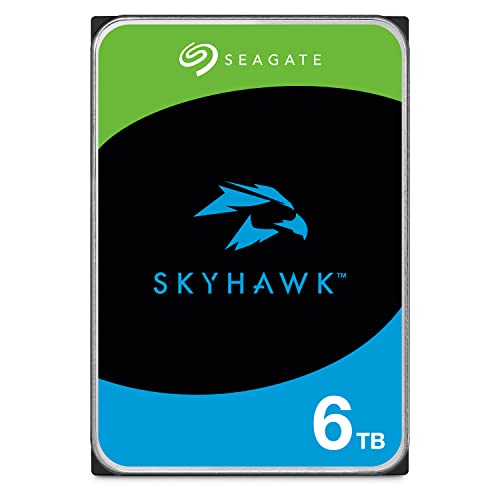
Best for: Multi-camera DVR and NVR systems
The Seagate SkyHawk 6TB is a 3.5-inch internal hard drive built for continuous security-video recording. It uses a SATA 6Gb/s connection and includes a 256MB cache. Its workload rating reaches 180TB per year, with support for up to 64 HD camera streams at once. Actual usable capacity will be lower after formatting and system overhead.
What sets this model apart is its focus on multi-camera storage. Built-in rotational vibration sensors help it maintain performance in systems with several drives, while its power-conscious design can reduce heat output. SkyHawk Health Management also provides drive monitoring tools. The listed price is around $215, though it changes over time. Buyers get a three-year limited warranty and three years of in-house Rescue Data Recovery Services. The advertised 1 million-hour MTBF is a reliability rating, not a guarantee that the drive will last that long.
Pros
- 6TB capacity gives many DVR and NVR systems substantial video storage.
- Supports up to 64 simultaneous HD camera streams and 180TB of yearly writes.
- Rotational vibration sensors suit multi-bay recording systems.
Cons
- As a mechanical hard drive, it is slower and less responsive than an SSD.
- The full 6TB is not available for files after formatting and system overhead.
5. REOLINK RLK8-520D4-5MP 8-Channel Security Camera System

Best for: Homeowners needing wired outdoor coverage
The REOLINK RLK8-520D4-5MP is a wired security kit with four 5MP PoE cameras and an eight-channel NVR. The recorder includes a 2TB hard drive, giving you local video storage without a monthly cloud subscription. At around $460, it targets homeowners who want several camera views from one central system. Each camera has a built-in microphone, so recorded footage can include nearby sound when audio recording is enabled.
Night coverage reaches up to 100 feet with the cameras’ infrared lights, although useful detail will depend on lighting and placement. The system can sort motion alerts by people, animals, and vehicles after updating to the latest firmware. That should reduce notifications from leaves or small objects compared with basic motion detection. Setup uses Ethernet-style PoE connections between the cameras and NVR, which simplifies power and video wiring. The Reolink app supports remote viewing and playback. The included 2TB drive is rated to hold about ten days of recordings before older files are overwritten, and the e-SATA port supports one external drive up to 8TB.
Pros
- Four 5MP cameras provide detailed video across multiple areas.
- Person, animal, and vehicle detection can reduce irrelevant alerts.
- Local 2TB storage avoids required cloud fees and supports remote playback.
Cons
- PoE wiring limits camera placement unless Ethernet cables can reach the NVR.
- Ten days of storage may be short with continuous recording, especially at multiple camera views.
4. Western Digital WD84PURZ 8TB Surveillance HDD

Best for: Multi-camera security recording systems
The Western Digital WD Purple WD84PURZ is an 8TB internal hard drive built for surveillance recorders. Its 3.5-inch design uses SATA 6 Gb/s, includes a 128 MB cache, and lists a data transfer rate of 194 megabits per second. It is designed for systems that write video footage continuously across multiple camera feeds.
Its main strength is its surveillance-focused workload support. The drive handles low-bit-rate recording with many active streams and works in systems with more than eight bays. Its standard workload rating reaches 180 TB per year. AllFrame AI technology raises the supported rate to as much as 360 TB per year for compatible AI-enabled recorders and systems. At around $425, it costs more than many general-purpose 8TB hard drives. That price makes the most sense for a security setup that records around the clock. Check your recorder’s approved-drive list before buying.
Pros
- 8TB capacity provides substantial room for stored camera footage.
- Supports multi-stream, write-intensive surveillance workloads.
- AllFrame AI supports up to 360 TB per year on compatible systems.
Cons
- Around $425 is expensive compared with many standard 8TB desktop drives.
- Its surveillance-focused design may offer limited value for ordinary PC storage.
3. ANNKE 3K Lite Wired Security Camera System

Best for: Homeowners covering large outdoor areas
ANNKE’s wired kit includes eight 2MP cameras, an eight-channel DVR, and a pre-installed 1TB hard drive. It records around the clock and uses H.265+ compression to reduce storage use and bandwidth needs. The recorder also supports up to a 10TB drive, plus 1080p cameras at 30 frames per second or 3K/5MP cameras at 20 fps. That gives buyers room to expand or replace cameras later.
Its strongest feature is smarter motion filtering. Human and vehicle detection can reduce alerts from animals or moving branches, while adjustable detection zones help focus on driveways, gates, or paths. The cameras switch between infrared and color night vision. They can show black-and-white images up to 100 feet, or color footage up to 66 feet when white lights are active. IP67 weather resistance suits outdoor mounting in rain and dust. At around $335, this is a substantial system for broad property coverage, but installation takes planning.
Pros
- Eight cameras cover multiple entry points without buying extra units.
- Human and vehicle alerts, plus smart recording search, can speed up video review.
- IP67 housings and dual-light night vision support outdoor use after dark.
Cons
- Wired installation requires power and video cable runs to every camera.
- The included 2MP cameras provide less detail than 4MP or 8MP models, especially for distant faces or license plates.
2. Seagate SkyHawk AI 8TB Internal HDD

Best for: Large AI-powered security camera systems
This 8TB internal hard drive is built for DVR and NVR security systems. It uses a 3.5-inch form factor, SATA 6Gb/s connection, and 256MB cache. The drive is intended for continuous video recording, rather than general desktop storage. At around $330, it costs more than many ordinary 8TB desktop hard drives, but its workload rating targets heavier surveillance use.
Its AI-focused design supports up to 64 HD video streams and 32 AI streams, giving larger camera systems room to grow. Seagate rates it for a 550TB annual workload and 2 million hours MTBF, both above typical consumer-drive figures. SkyHawk Health Management adds monitoring, recovery guidance, and RAID RapidRebuild, which can rebuild volumes up to three times faster than traditional RAID rebuilds. Buyers also get a five-year limited warranty and three years of in-house Rescue Data Recovery Services. These protections add value for important recordings, though they do not guarantee every failed drive can be recovered.
Pros
- 8TB capacity supports large video archives.
- Handles up to 64 HD and 32 AI streams.
- Five-year warranty and three years of recovery services are included.
Cons
- Around $330 makes it a costly choice for basic, low-camera setups.
- As a mechanical HDD, it is slower and less shock-resistant than an SSD, and it requires a compatible 3.5-inch SATA bay.
1. Seagate SkyHawk ST4000VXZ16 Surveillance HDD

Best for: Multi-camera home security DVRs
The Seagate SkyHawk ST4000VXZ16 is a 4TB, 3.5-inch internal HDD made for DVR and NVR security systems. It uses a SATA 6Gb/s connection and includes a 64MB cache. That gives a compatible recorder room for extended video storage, though actual recording time depends on camera resolution, frame rate, and retention settings. Around $160, it costs more than a basic desktop hard drive but is designed for continuous surveillance workloads.
Seagate rates this model for up to 180TB of yearly writes and as many as 64 simultaneous HD camera streams without dropped frames. Built-in rotational vibration sensors help it maintain performance in multi-drive enclosures. Its lower power use can reduce heat inside a crowded recorder, while SkyHawk Health Management helps monitor drive condition. The package also includes a three-year limited warranty and three years of in-house Rescue Data Recovery Services. The listed 1 million-hour MTBF figure offers a reliability benchmark, not a guaranteed service life.
Pros
- 4TB capacity suits many home and small-business surveillance systems.
- Rated for up to 64 simultaneous HD camera streams.
- Rotational vibration sensors support multi-drive DVR and NVR setups.
Cons
- It is a mechanical HDD, so it is slower and less shock-resistant than an SSD.
- Actual storage duration varies sharply with camera count, resolution, and recording settings.
Buying Guide
The most important factor is a surveillance workload rating, because recorders write video 24 hours a day. Choose a drive built for continuous recording, not a desktop model designed for occasional file storage.
- 24/7 workload rating: Look for at least 180TB per year, which suits many home and small-business systems recording constantly.
- Storage capacity: Estimate your retention needs first. Four 1080p cameras at 2Mbps each can use about 2.6TB every 30 days, so a 4TB drive provides limited extra space.
- Recording method: Choose CMR recording instead of SMR. CMR handles repeated video writes more consistently, especially when several cameras record at once.
- Recorder compatibility: Confirm the NVR or DVR accepts 3.5-inch SATA drives and supports the chosen capacity. Some older units limit storage to 4TB or 6TB per bay.
- Warranty and noise: A three-year warranty is a reasonable minimum. For indoor offices, check noise ratings and consider a 4TB to 8TB surveillance drive rather than a louder enterprise disk.
If you cannot meet every requirement, prioritize the 24/7 workload rating and CMR design.
Frequently Asked Questions
How much storage do security cameras need?
A security camera system usually needs 1TB to 8TB, depending on camera count, resolution, recording hours, and retention time. A four-camera setup recording continuously at 1080p may need about 1TB for roughly one week, while 4K footage fills drives faster.
What type of hard drive is best for a security camera DVR?
A surveillance-rated hard drive is the best choice for a security DVR because it is designed for continuous recording and multiple simultaneous video streams. Models in this class commonly support workloads around 180TB per year, while desktop drives may be intended for far less.
Can I use a regular desktop HDD in a security camera recorder?
You can use a regular desktop HDD in some camera recorders, but a surveillance drive is safer for nonstop recording and repeated overwrite cycles. Check the recorder’s compatibility list first, since some systems limit capacity or accept only SATA drives up to a stated size.
Are surveillance hard drives worth it for home security cameras?
Surveillance hard drives are usually worth the extra cost for home cameras that record around the clock. For example, 4TB can store roughly several weeks of 1080p footage on a small system, though motion-only recording can extend that figure substantially.
Conclusion
Seagate SkyHawk ST4000VXZ16 Surveillance HDD is the top recommendation for buyers who need a 4TB drive for a multi-camera home or small-business recorder. If your priority is longer video retention instead of a lower upfront cost, choose a higher-capacity surveillance drive, since extra space can preserve more days of footage before older files are overwritten. Before buying, double-check the drive’s physical size, recorder compatibility, supported drive quantity, and current price, then compare those details with your camera setup; continuous recording uses far more storage than motion-triggered footage, and some recorders limit capacity or accept only specific drive types. A proper match matters more than a low sticker price.