
6 Best HVAC Carbon Monoxide Detector for RVs
The Klein Tools ET110 CO Meter, Carbon Monoxide Detector is the top pick for most buyers, and it earns the title of best hvac carbon monoxide detector because it provides clear carbon monoxide readings for HVAC checks. Its handheld format fits service calls, furnace inspections, and basic home safety checks. The meter also gives users a direct reading instead of relying only on a warning light or alarm.
This guide is for HVAC technicians, landlords, maintenance workers, and homeowners checking fuel-burning equipment. The key factors include measurement range, display readability, alarm settings, physical size, and battery life. A compact meter is easier to carry, while a clear screen helps users spot changing readings quickly. The six picks below are ranked by practical value, with specific reasons and honest drawbacks for each. That makes it easier to choose a detector for occasional checks or regular service work.
Quick Comparison
| # | Product | Best For | Price | |
|---|---|---|---|---|
| 1 | Klein Tools ET110 CO Meter, Carbon Monoxide Detector | HVAC technicians checking combustion appliances | ~$130 | View → |
| 2 | TOPTES CT-580 Portable Carbon Monoxide Detector | Travelers needing portable CO alerts | ~$66 | View → |
| 3 | Forensics Carbon Monoxide CO Meter | Forensic investigators documenting CO exposure | ~$99 | View → |
| 4 | Sensorcon Inspector 2 Portable CO Monitor | Industrial workers monitoring confined spaces | ~$164 | View → |
| 5 | Kidde Carbon Monoxide and Gas Alarm | Families wanting home gas protection | ~$57 | View → |
| 6 | TOPTES CT-913 Portable Carbon Monoxide Detector | Drivers checking vehicle exhaust leaks | ~$76 | View → |
6 Top HVAC Carbon Monoxide Detectors
These six HVAC carbon monoxide detectors are ranked by alert features, installation options, and value, counting down to the top pick.
6. TOPTES CT-913 Portable Carbon Monoxide Detector

Best for: RV owners and field inspectors
The TOPTES CT-913 is a rechargeable carbon monoxide meter for homes, RVs, garages, boats, workshops, and job sites. It measures from 0 to 1,000 PPM and shows current readings on a TFT color screen. A built-in trend graph helps users track whether CO levels are rising or falling. The unit uses a 4,000mAh battery and is rated for more than 60 hours per charge. USB-C charging makes it practical for travel or extended inspections.
Its upgraded UK DDS electrochemical sensor is designed to respond quickly to concentration changes. When readings reach a selected limit, the detector can use sound, screen alerts, and vibration at the same time. Other useful controls include brightness adjustment, automatic screen shutoff, zero calibration, and stored alarm records. The industrial-grade ABS case should handle normal field use, while the included storage case adds protection in transit. At around $76, it costs more than a basic home alarm, but offers more measurement detail and control.
Pros
- Displays real-time CO levels from 0 to 1,000 PPM.
- Triple alerts combine audible, visual, and vibration warnings.
- More than 60 hours of claimed battery life supports longer trips.
Cons
- The 1,000 PPM ceiling may not suit every high-concentration industrial application.
- The price is high for buyers who only need a basic home alarm.
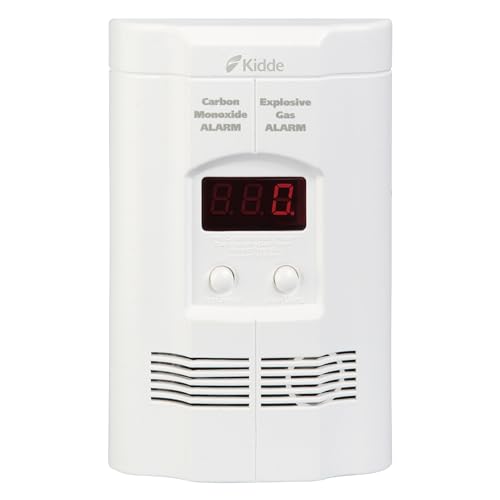
5. Kidde Carbon Monoxide and Gas Alarm
Best for: Homes with gas appliances
This Kidde alarm monitors carbon monoxide and explosive gases, including natural gas and propane. It plugs into a standard 120V household outlet, so setup does not require hardwiring. A 9-volt battery backup keeps the unit powered during an outage. That backup is useful near furnaces, water heaters, kitchens, and other gas-burning equipment.
Its digital LED display gives more information than a basic alarm. For carbon monoxide, it shows the level the sensor detects. When explosive gas is present, the screen displays “GAS” instead. An 85-decibel alarm provides a loud warning, while separate LED status lights show the unit’s condition. Peak Level Memory records the last detected carbon monoxide reading and the most recent test event. That record can help identify a problem that occurred while nobody was home. Still, this is a warning device, not a replacement for appliance maintenance or professional gas inspection. At around $57, it costs more than simple plug-in CO alarms, but it covers more hazards.
Pros
- Detects carbon monoxide, natural gas, and propane in one unit.
- 9-volt backup battery maintains protection during power failures.
- Peak Level Memory records a prior CO event or test.
Cons
- It needs an available 120V outlet, which may limit placement.
- The display reports “GAS” for explosive gas instead of showing its concentration.
4. Sensorcon Inspector 2 Portable CO Monitor

Best for: HVAC technicians and inspectors
The Sensorcon Inspector 2 is a portable carbon monoxide monitor for professional work. It displays CO levels from 1 to 1,999 ppm, with readings shown in 1 ppm steps. That range fits HVAC service, building inspections, emergency response, and commercial facility checks. The unit costs around $164, which places it above basic household alarms.
Its strongest feature is the three-part alert system. When CO reaches a set level, the monitor uses an LED, an 80–85 dB alarm, and vibration at the same time. Factory thresholds are 35 ppm for low and 200 ppm for high alerts, based on NIOSH occupational levels. Response takes less than five seconds, and MAX mode records the highest detected level. The IP67-rated housing is built for wet, dusty, and rough job sites. A steel clip and lanyard support hands-free wear. The replaceable CR123A battery may last two to four years, and the unit includes a two-year warranty.
Pros
- Reads from 1 to 1,999 ppm with 1 ppm resolution.
- Combines visual, audible, and vibration alerts.
- IP67 protection and a steel clip suit field work.
Cons
- It is not intended for formally classified hazardous locations.
- The professional features raise the price above simple home CO alarms.
3. Forensics Carbon Monoxide CO Meter

Best for: Home garages, workshops, and boilers
The Forensics Carbon Monoxide Meter is a portable CO detector for indoor work areas, garages, utility rooms, and similar spaces. It measures from 0 to 1,000 ppm, with 1 ppm resolution, using an electrochemical sensor. The listed accuracy is better than ±5% of full scale, and the response time is under 30 seconds. It arrives factory calibrated with a USA NIST calibration and quality assurance certificate.
Its strongest feature is the combination of three alarm types. When CO reaches a preset level, the meter can sound, flash, and vibrate. That helps in noisy rooms or places where a visual warning may be missed. Users can adjust the alarm points and perform zero or span calibration. The 1,500mAh rechargeable lithium-ion battery charges through micro-USB. A belt clip supports portable use. The manufacturer also lists shock, water, dust, and explosion protection. Around $99, it costs more than basic household alarms, but it offers measurement data instead of a simple warning.
Pros
- Measures CO from 0 to 1,000 ppm with 1 ppm resolution.
- Sound, light, and vibration alerts suit noisy or low-visibility work areas.
- Rechargeable 1,500mAh battery and belt clip support mobile inspections.
Cons
- No battery runtime is provided, so charging intervals are unclear.
- The listing does not provide an IP rating or detailed certification for its water and explosion protection.
2. TOPTES CT-580 Portable Carbon Monoxide Detector

Best for: Campers checking cabins and vehicles
The TOPTES CT-580 is a handheld carbon monoxide meter for spot checks at home, campsites, vehicles, workshops, and other work areas. It measures CO from 0 to 1,000 PPM and uses a DDS sensor with a stated response time of 0.3 seconds. A TFT color screen shows readings and alarm status clearly. At around $66, it costs more than a basic plug-in alarm, but it offers more inspection controls.
Its strongest feature is the three-part alert system. When CO reaches a set threshold, the indicator light, audible alarm, and vibration activate together. That helps in noisy spaces or poor visibility. The unit has two alarm thresholds, adjustable brightness, auto screen-off, and a built-in flashlight. Business users also get alarm history and zero or standard-gas calibration menus. Its ABS housing suits regular carrying, while USB-C charging avoids a dedicated charger. The package includes a protective case, cable, and manual. Certification from a nationally accredited lab adds useful documentation. This is a portable inspection instrument, not a replacement for fixed household CO alarms.
Pros
- Measures a broad 0 to 1,000 PPM range with a stated 0.3-second response.
- Combines visual, audible, and vibration alerts for easier detection.
- Includes calibration menus, alarm history, a flashlight, and USB-C charging.
Cons
- It is designed for manual checks, not continuous monitoring from a fixed location.
- The listed information does not specify battery runtime or recharge time.
1. Klein Tools ET110 CO Meter, Carbon Monoxide Detector

Best for: Home inspectors and HVAC technicians
The Klein Tools ET110 is a handheld carbon monoxide meter for checking CO levels in homes, garages, work areas, and equipment spaces. Its display reads from 0 to 1,000 ppm and also shows temperature in Fahrenheit or Celsius. A backlight helps with readings in dim areas. The package includes four AAA batteries and a carrying pouch, so it can be stored and transported without buying basic accessories first.
What sets this meter apart is its two-level warning system. It gives a low alarm at 35 ppm and a high alarm at 200 ppm, using both sound and visual indicators. It also includes a short-term exposure limit alarm for added monitoring. The auto-shutoff turns the unit off after 20 minutes without activity, which helps reduce battery drain but may interrupt extended checks. At around $130, it costs more than simple household CO alarms. Its value depends on needing portable measurements rather than basic room protection.
Pros
- Measures CO from 0 to 1,000 ppm with temperature readings.
- Uses audible and visual alerts at 35 ppm and 200 ppm.
- Includes four AAA batteries and a carrying pouch.
Cons
- It is a spot-check meter, not a permanently installed household alarm.
- The 20-minute auto-shutoff can interrupt longer monitoring sessions.
Buying Guide
Certification and sensor type matter most when choosing a carbon monoxide alarm for an HVAC system. A UL 2034-listed model with an electrochemical sensor gives you a recognized safety standard and strong response to low-level CO.
- Certification: Choose a unit marked UL 2034 or CSA 6.19. Avoid products that list only “tested to” a standard without certification.
- Sensor type: Select an electrochemical sensor rather than a basic biomimetic or metal-oxide model. Replace the alarm after seven to ten years, based on its label.
- Power source: Pick a plug-in alarm with battery backup, or a battery model with a sealed 10-year cell. Replaceable batteries should last at least 12 months.
- Alarm output: Look for an alarm rated at 85 decibels or louder at 10 feet. A digital display helps show current readings and error codes.
- Placement and coverage: Install alarms outside sleeping areas and on every level with fuel-burning equipment. Keep one at least 15 feet from a furnace, boiler, fireplace, or water heater to reduce false alarms.
- Cost and pack size: Expect about $25 to $60 for a single reliable unit, or $70 to $150 for a two- or three-pack. Interconnected models cost more but alert occupants throughout the home.
If you cannot have everything, prioritize UL 2034 certification and an electrochemical sensor.
Frequently Asked Questions
How should I place a carbon monoxide detector near an HVAC system?
Place a carbon monoxide detector in the same home zone as the furnace, but not directly above the appliance or inside a mechanical room. Mount it about 5 feet above the floor, near sleeping areas, and follow the manufacturer’s distance rules. Carbon monoxide mixes with air, so height is less critical than clear access.
What features matter most in an HVAC carbon monoxide alarm?
Look for an alarm with an electrochemical sensor, a loud alarm, a digital carbon monoxide reading, and a test button. Battery backup matters if the unit plugs into an outlet. A useful display shows parts per million, while a sealed 10-year battery reduces maintenance. Check that the alarm carries UL 2034 certification.
Can a CO detector protect my home from furnace leaks?
Yes, a CO detector can warn you about dangerous carbon monoxide from a furnace leak, but it cannot prevent the leak or replace professional service. Have fuel-burning equipment inspected yearly, keep vents clear, and leave the home after an alarm sounds. Some alarms display readings from 30 to 999 ppm.
Are HVAC carbon monoxide detectors different from standard home alarms?
No, most HVAC-focused carbon monoxide alarms use the same basic sensing approach as household CO detectors; the main differences involve mounting, power, display, and smart-home features. Choose a listed alarm for the fuel-burning equipment in your home. Replace many units after 7 to 10 years, based on the label.
Conclusion
The Klein Tools ET110 CO Meter, Carbon Monoxide Detector, suits HVAC technicians, landlords, and homeowners who need portable readings around furnaces, boilers, water heaters, and vents. If your priority is round-the-clock household warning rather than spot checks, choose a listed plug-in or battery-powered alarm with a loud siren and backup power. Before buying, double-check the meter’s size, compatibility with your planned inspection points, package quantity, and current price, since listings can change. Also confirm the sensor’s measurement range, display style, battery requirements, and any required calibration schedule. A portable meter can help locate a concern, but it should not replace certified alarms installed near sleeping areas. Keep both tools maintained and ready.