
6 Best Battery Jump Starter for Boat for Emergencies
S ZEVZO ET03 Car Jump Starter is the top pick for most buyers seeking the best battery jump starter for boat because it combines emergency starting power with a compact, portable design. It is built primarily as a car jump starter, yet that format suits boat owners who need a backup power tool for engines, cars, trailers, or marina equipment.
This guide is for boat owners, anglers, and weekend cruisers who want a small rescue device aboard. The key details are stated peak starting current, battery capacity, water resistance, and case durability. A jump starter needs enough output for the engine size, while its housing should handle damp storage areas and rough transport. The six picks below are ranked with clear reasons and honest drawbacks for each, so you can match the unit to your boat and emergency kit.
Quick Comparison
| # | Product | Best For | Price | |
|---|---|---|---|---|
| 1 | S ZEVZO ET03 Car Jump Starter | Drivers Wanting Emergency Roadside Backup | ~$60 | View → |
| 2 | WOLFBOX MV24 Portable Jump Starter | SUV Owners Needing Extra Starting Power | ~$108 | View → |
| 3 | TREKURE Portable Car Battery Jump Starter | Budget-Conscious Everyday Commuters | ~$50 | View → |
| 4 | NOCO Boost GB40 Portable Lithium Jump Starter | Compact Car Owners | ~$90 | View → |
| 5 | NOCO Boost GB50 Jump Starter | Pickup Truck And SUV Drivers | ~$150 | View → |
| 6 | GOOLOO GP4000 Jump Starter | High-Output Power Users | ~$80 | View → |
6 Top Boat Jump Starter Picks
This list ranks six boat-friendly jump starters, counting down from the sixth choice to the top pick for emergency power.
6. GOOLOO GP4000 Jump Starter

Best for: Roadside help for large engines
The GOOLOO GP4000 is a portable 12V jump starter for cars, trucks, RVs, tractors, motorcycles, ATVs, snowmobiles, and boats. Its 4,000-amp rating is designed for gasoline and diesel engines up to 10.0 liters. A BOOST button can help start batteries with very low voltage, but the vehicle still needs a compatible 12V system and clean, firmly attached terminals.
It also works as a power bank, with two USB outputs, including one fast-charging port, plus a USB-C input rated at 5V/3A. The built-in flashlight helps during nighttime breakdowns. Hardened plastic, rubber corners, and all-metal clamps give the kit a durable design. GOOLOO claims more than 60 starts on a full charge, though actual results depend on the vehicle and battery. The unit is rated for -4°F to 140°F, and its protection system covers 10 misuse and electrical hazards. The kit includes smart cables, a USB-C cable, a cigarette-lighter adapter, an EVA case, an 18-month warranty, and lifetime tech support, but no wall charger. Around $80, it suits drivers who want one pack for jump-starting and device charging.
Pros
- Supports engines up to 10.0L, including diesel models.
- Two USB ports and USB-C charging support phones and other devices.
- Metal clamps, rubber corners, and a storage case suit roadside use.
Cons
- A wall charger is not included, so buyers need a compatible charger.
- It should be recharged every 2–3 months during storage.
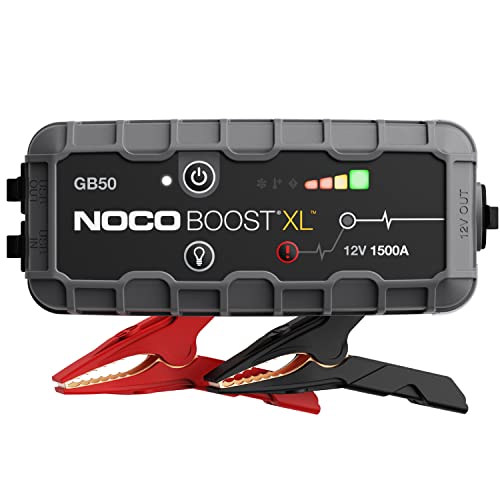
5. NOCO Boost GB50 Jump Starter
Best for: Drivers building a serious emergency kit
The NOCO Boost GB50 is a 12V lithium jump starter for cars, trucks, and other vehicles. Its 1,500-amp peak output can provide up to 30 starts per charge, with stated limits of 7.0-liter gas engines and 4.5-liter diesel engines. At 2.7 pounds, it is portable enough for a glove box, though it is heavier than many compact power banks.
Safety is a major strength. Spark-proof protection and reverse-polarity detection help reduce mistakes when connecting the clamps. The rugged housing has an IP65 rating and rubberized over-molding for protection from dust, water spray, and drops. It also works as a power bank for phones and tablets, then recharges in about five hours. A 200-lumen LED flashlight adds seven modes, including SOS and strobe, for roadside repairs or emergencies. Around $150, it costs more than basic jump packs, but the broader feature set adds value. The box includes clamps, a USB-C charging cable, and a microfiber bag. A wall charger is not listed.
Pros
- 1,500 amps can start engines up to 7.0 liters gas or 4.5 liters diesel.
- Reverse-polarity and spark-proof protection make connections safer for less experienced users.
- IP65 housing, flashlight modes, and device charging support roadside emergencies.
Cons
- At 2.7 pounds, it takes more space and weight than smaller jump starters.
- The roughly $150 price is high, and the package does not list a wall charging adapter.
4. NOCO Boost GB40 Portable Lithium Jump Starter

Best for: drivers building a roadside emergency kit
The NOCO Boost GB40 is a portable 12V jump starter for cars, trucks, and other vehicles. Its 1,000-amp lithium battery is rated for up to 20 starts per charge on gasoline engines up to 6.0 liters and diesel engines up to 3.0 liters. At 2.5 pounds, it can fit in many glove boxes without taking up much room. Around $90, it costs more than basic jumper cables but adds several emergency tools.
Safety is a strong point. Spark-proof technology and reverse-polarity protection help reduce connection mistakes when attaching the included clamps. The unit also works as a power bank for phones and tablets, then recharges in about three hours. Its 100-lumen LED flashlight has seven modes, including SOS and strobe. The IP65 housing resists dust and water, while rubberized over-molding helps protect against bumps. The box includes a USB-C cable, clamps, microfiber storage bag, and a one-year warranty. It does not include a wall charger.
Pros
- 1,000 amps can start gasoline engines up to 6.0 liters and diesel engines up to 3.0 liters.
- Reverse-polarity and spark-proof protection make clamp connections less stressful.
- Seven flashlight modes and phone charging add useful roadside backup.
Cons
- The 2.5-pound body may feel bulky in smaller glove boxes.
- The listed three-hour recharge time requires access to a suitable USB power source, and no wall charger is included.
3. TREKURE Portable Car Battery Jump Starter

Best for: Drivers wanting compact roadside backup
The TREKURE TK60 is a compact jump starter rated at 5000A. It is designed for vehicles with engines up to 10L on gas or 8L on diesel, including cars, trucks, motorcycles, boats, and lawnmowers. Its force-start feature is intended for fully drained 0V batteries, though actual results depend on the vehicle and battery condition. At 0.8 pounds, the unit fits easily in a glove compartment or tool bag. A detachable rubber lanyard also supports handheld or hanging use.
The built-in 2000-lumen, full-panel LED light is the most useful extra. Its magnetic back can attach to metal under the hood, and it offers lighting, strobe, red strobe, and SOS modes. The unit also works as a power bank for phones, tablets, and other USB devices, using four internal battery packs. Smart clamps provide 10 listed safety protections, while the V0-rated casing adds flame resistance. Around $50, it includes two years of returns and lifetime technical support.
Pros
- 5000A output supports engines up to 10L gas or 8L diesel.
- Magnetic 2000-lumen light provides hands-free roadside illumination.
- Compact 0.8-pound design doubles as a USB power bank.
Cons
- Claimed engine capacity does not guarantee a start with every drained or damaged battery.
- The listing does not provide battery capacity, recharge time, or expected phone-charge count.
2. WOLFBOX MV24 Portable Jump Starter

Best for: Drivers of large 12V vehicles
The WOLFBOX MV24 is a portable 12V jump starter for cars, trucks, boats, and other vehicles with gasoline or diesel engines under 10 liters. Its 88.8Wh battery and claimed 4000A peak output target larger engines, while the one-touch boost feature helps when a vehicle battery has very low voltage. Jumper cables and an LED light are included for roadside use.
Charging is a strong point. The USB-C port supports 65W input and output, and the included PD65W charger can refill the pack in about 1.3 hours. A QC3.0 USB-A port adds another option for phones, tablets, or smaller devices. The LCD screen shows battery and operating status without guesswork. The flashlight offers high-beam, SOS, and strobe modes. It is rated for temperatures from -4 to 140°F and carries an IP64 protection rating. Around $108, it costs more than basic jump packs, but offers more charging capacity and display information.
Pros
- 88.8Wh capacity and 4000A output support 12V gasoline and diesel engines under 10 liters.
- 65W USB-C charging can refill the unit in about 1.3 hours.
- LCD status readout and three flashlight modes aid roadside emergencies.
Cons
- It works with 12V systems only, so it is not suitable for 24V commercial vehicles.
- IP64 protection does not make the pack waterproof, and incorrect clamp polarity can cause damage.
1. S ZEVZO ET03 Car Jump Starter

Best for: Drivers wanting a high-capacity emergency jump pack
The S ZEVZO ET03 is a portable 12V jump starter for cars, trucks, motorcycles, lawnmowers, and boats. Its 4,000-amp peak rating supports gasoline engines up to 8.0 liters and diesel engines up to 7.0 liters. The 74Wh battery can provide up to 50 starts per charge, though actual results depend on battery condition and temperature. Around $60, it costs more than basic compact boosters.
Its force-start function can help revive batteries reading 0V, but the pack must be fully charged or show more than 14V first. Two 5V/2A USB ports can charge separate devices at the same time, while the LCD shows remaining power. A 500-lumen light offers steady, strobe, and SOS modes. The kit includes smart clamps, a USB Type-C charging cable, a storage case, and a manual. It also lists operation from 14°F to 140°F and up to 24 months of standby time.
Pros
- Supports large engines, including up to 8.0L gas and 7.0L diesel.
- Two USB outputs charge phones or tablets simultaneously.
- The 500-lumen light includes steady, strobe, and SOS settings.
Cons
- A fully dead 0V battery requires the jump pack to be above 14V.
- The 4,000-amp figure is a peak rating, not a continuous output rating.
Buying Guide
The most important factor is starting power matched to your engine size and battery voltage. A unit with too little current may fail on a cold 12-volt outboard, while extra capacity adds cost and weight.
- Starting current: Choose a model rated for your engine. Small outboards often need 800-1,000 peak amps, while larger inboards may require 1,500-2,000 amps. Follow the engine maker’s guidance first.
- Voltage and battery type: Confirm compatibility with your boat’s battery. Most recreational boats use 12-volt lead-acid or AGM batteries, but a 24-volt system requires a compatible starter.
- Water and salt protection: Look for at least an IP65 rating, rubber port covers, and sealed housing. No portable booster is fully waterproof, so store it in a dry case.
- Battery capacity: Aim for 10,000-20,000 mAh for emergency starting plus phone or radio charging. A USB-C input can shorten recharge time to roughly 3-5 hours.
- Cables and safety controls: Select thick cables with clamps that fully grip standard battery posts. Reverse-polarity, short-circuit, and overheat protection reduce mistakes near fuel and water.
If you cannot have everything, prioritize the correct starting-current rating for your boat’s engine.
Frequently Asked Questions
How many amps should a boat jump starter have?
Choose a jump starter rated for your boat’s engine size, with at least 1,000 peak amps for small gasoline engines and 1,500 to 2,000 amps for larger outboards or diesel motors. Check the engine manual before buying, since peak ratings vary by brand and do not equal cranking amps.
What features matter in a jump starter for boats?
Look for a 12-volt unit with reverse-polarity protection, spark-resistant clamps, a sealed or water-resistant case, and enough cable length to reach the battery safely. An IP67-rated model can handle brief water exposure better than an unsealed charger, but it should still be stored dry after use.
Can a portable battery pack start a marine engine?
Yes, a marine jump starter can start a boat engine if it matches the battery voltage and supplies enough current for that motor. Most recreational boats use 12-volt systems, while some larger setups use 24 volts, so confirm the system before connecting the clamps.
Are lithium jump starters better for boat owners?
Yes, lithium jump starters are usually the most practical choice for boats because they weigh less and hold a charge longer than lead-acid packs. Some compact models weigh about 2 to 3 pounds and include USB ports for emergency phone charging at sea, though cold weather can reduce their output.
Conclusion
The S ZEVZO ET03 Car Jump Starter is the top pick for boat owners who want a compact backup for starting smaller engines and vehicles around the marina. If your priority is starting a larger marine engine, pick a higher-output marine jump starter with cables sized for that load instead. Before buying, double-check the unit’s size for your storage locker, compatibility with your engine and battery type, the quantity of jump starters you need, and the current price from the seller. Keep the pack charged between trips, and store it away from spray, heat, and direct sun. A clear return policy also helps if the listed fit proves inaccurate.