
6 Best Lightning Detector Picks for Storm Safety
For most buyers, the AcuRite 02020 Portable Lightning Detector is the best lightning detector because it gives straightforward storm alerts in a small, battery-powered unit. Its portable design makes it useful for patios, campsites, and travel, while the distance display helps you judge how close a storm may be.
This guide is for anyone who wants early warning without relying on a weather app alone. The key factors are detection range, alert clarity, size, and battery life, since a detector must notice distant strikes and remain easy to carry. The six picks below are ranked with clear reasons and honest drawbacks for each, so you can choose the right model for your home, vehicle, or outdoor kit.
Quick Comparison
| # | Product | Best For | Price | |
|---|---|---|---|---|
| 1 | AcuRite 02020 Portable Lightning Detector | Hikers Needing Portable Storm Alerts | ~$46 | View → |
| 2 | StrikeAlert HD Lightning Detector | Golfers Watching Approaching Thunderstorms | ~$204 | View → |
| 3 | Ambient Weather WH31L Lightning Detector | Homeowners Monitoring Outdoor Weather | ~$70 | View → |
| 4 | AcuRite 06045M Lightning Detector Sensor | Weather Station Expansion Buyers | ~$27 | View → |
| 5 | AcuRite 02021 Portable Lightning Detector | Campers Wanting Pocket-Sized Detection | ~$45 | View → |
| 6 | Robic Strike Alert Personal Lightning Detector | Runners Seeking Personal Storm Warnings | ~$73 | View → |
6 Lightning Detectors Worth Considering
These picks are ranked by detection range, alert clarity, portability, and value, counting down to the top choice.
6. Robic Strike Alert Personal Lightning Detector

Best for: Golfers and outdoor event crews
The Robic Strike Alert is a compact personal lightning detector for golf courses, campsites, and outdoor work areas. Its impact-resistant body clips to a belt, golf bag, or backpack, so it can stay within reach when weather changes. A single AA battery powers the unit for up to 100 hours, though actual life depends on use and battery condition.
The detector uses both sound and light to report nearby lightning activity. An audible alarm sounds when it detects a strike, while an LED lights at the same time. A pulsing LED pattern helps show whether strikes are getting closer or moving away. A simple switch lets you check the estimated strike distance without working through menus or buttons. Around $73, it costs more than basic weather-alert devices, but the dedicated warning system may appeal to people who spend long periods outdoors. Its small size also keeps it easier to carry than larger storm-monitoring equipment.
Pros
- Audible alarm and matching LED provide two warning methods.
- Pulsing light pattern indicates approaching or receding lightning activity.
- Clips to belts, golf bags, or backpacks and runs up to 100 hours on one AA battery.
Cons
- The listed features do not state that the detector is waterproof or weatherproof.
- A single AA battery is required, and the 100-hour figure is a maximum estimate rather than a guaranteed runtime.
5. AcuRite 02021 Portable Lightning Detector

Best for: Golfers and outdoor storm watchers
The AcuRite Portable Lightning Detector is a pocket-size warning device for outdoor activities. It detects cloud-to-ground, cloud-to-cloud, and intra-cloud lightning within up to 25 miles, or 40 kilometers. When it senses activity, the unit sounds an alarm, flashes a red LED, and displays a warning message. A running strike count helps show how active the storm has become.
Its backlit screen also provides an estimated distance to the storm front, so you get more context than an alarm alone. The belt clip keeps it accessible on a golf course, hiking trail, campsite, fishing spot, sideline, or job site. Indoor and outdoor modes adjust the detector for different settings, while interference rejection helps limit false alerts. Power comes from batteries or a USB-C input. Around $45, it offers useful storm awareness without requiring a phone connection, though its compact design leaves room for only basic information.
Pros
- Detects three types of lightning activity up to 25 miles away.
- Combines an audible alarm, red LED, and screen warning.
- Displays both strike count and estimated storm distance.
Cons
- The distance reading is an estimate, not a precise storm location.
- The listed features do not provide a battery runtime, so frequent users may need spare batteries or USB-C access.
4. AcuRite 06045M Lightning Detector Sensor

Best for: Existing AcuRite weather station owners
The AcuRite 06045M is an outdoor replacement sensor for select AcuRite weather stations. It detects lightning strikes from up to 25 miles, or 40 kilometers, away, then provides light and audible alerts. It also records outdoor temperature and humidity, giving compatible consoles more useful local weather data. The weather-resistant housing suits outdoor placement, but it still needs a clear, practical location within wireless range.
Data normally transmits every 24 seconds. After lightning is detected, that interval drops to every 8 seconds, which can provide faster storm updates. The wireless range reaches up to 330 feet, or 100 meters, under suitable conditions. Compatibility is limited to models 01021, 01022, 02080, 06046, and 06047. For remote viewing, it can connect to My AcuRite through an AcuRite Access hub, sold separately. That setup supports app access plus phone and email alerts. At around $27, it costs less than replacing an entire weather station.
Pros
- Detects lightning within a 25-mile range and provides light and audible alerts.
- Measures both outdoor temperature and humidity in one weather-resistant sensor.
- Sends updates every 8 seconds after lightning detection, with wireless coverage up to 330 feet.
Cons
- Works only with specific AcuRite weather station models, so it is not a universal add-on.
- Remote app monitoring requires the separately sold AcuRite Access hub.
3. Ambient Weather WH31L Lightning Detector

Best for: Home weather station owners tracking storms
The Ambient Weather WH31L is a standalone lightning detector for the WS-2000 and WS-5000 weather stations. It identifies lightning strikes within 25 miles, or 40 kilometers, of your location. The package includes one compact sensor, measuring 4.75 by 1.5 by 0.6 inches. That small footprint makes it easier to place near an existing weather setup without adding much clutter.
The sensor communicates over 915 MHz and has a rated range of up to 330 feet. Ambient Weather says real-world range is closer to 100 feet in most conditions, so placement and walls matter. It updates about every 79 seconds, which gives you storm information without requiring a wired connection. Two AA batteries come included, and around $70 is a reasonable estimate for this add-on, though prices change. Its main appeal is simple: it adds nearby lightning alerts to compatible weather stations without requiring a separate full-size monitoring system.
Pros
- Detects lightning within a broad 25-mile, or 40-kilometer, radius.
- Compact 4.75-inch sensor fits beside many weather station components.
- Includes two AA batteries, so setup does not require an immediate battery purchase.
Cons
- The 79-second refresh rate may not provide instant strike updates.
- Wireless range can fall to about 100 feet in typical conditions, especially around walls and other obstructions.
2. StrikeAlert HD Lightning Detector

Best for: Campers, golfers, and outdoor crews
StrikeAlert HD is a personal lightning detector for people who spend time outside. It shows how far away lightning is, using four distance bands: 24–40 miles, 12–24 miles, 6–12 miles, and under 6 miles. Its display also tracks the storm’s one-hour trend, giving you more context than a simple alarm.
The detector monitors lightning in all directions, so its coverage does not depend on which way you face it. Audible and vibration alerts can warn you before, and while, lightning reaches the listed striking-distance range. Two AA batteries provide up to 80 hours of operation, and an optional two-hour shutoff helps conserve power when no strikes occur. At around $204, this is a specialized safety tool rather than a casual purchase.
Pros
- Tracks lightning in all directions instead of relying on a single sensing path.
- Shows four distance ranges, from 24–40 miles to under 6 miles.
- Offers both sound and vibration alerts, with up to 80 hours of battery life.
Cons
- Around $204, it costs much more than basic weather-alert devices.
- It uses two disposable AA batteries and does not replace an official weather warning system.
1. AcuRite 02020 Portable Lightning Detector
Best for: Campers tracking nearby thunderstorms
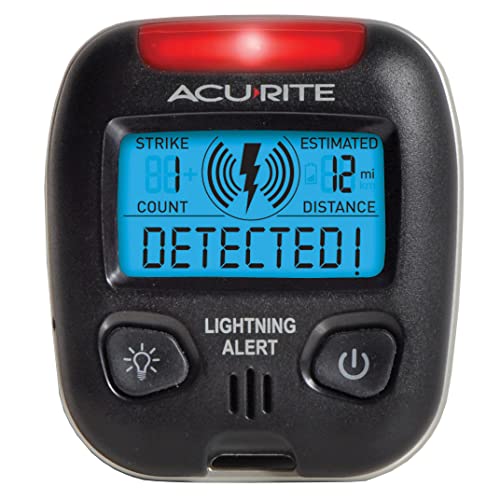
The AcuRite 02020 is a small, portable lightning detector for outdoor planning and storm awareness. It measures about 2½ inches long, 1 inch wide, and 2¾ inches high, so it can fit in a pocket, gear bag, or vehicle console. The unit detects lightning and storms within a 25-mile range. It also estimates the storm’s distance when lightning is detected, giving you more useful information than a simple flash warning.
A warning light and audible alarm provide quick alerts, while text notifications add another way to receive updates. The built-in strike counter keeps a running total of detected lightning strikes, which helps show whether storm activity is increasing. A momentary backlight makes the display easier to read in low light, but it will not keep the screen illuminated. At around $46, this detector costs more than a basic weather alert, yet its distance estimates and strike count may suit campers, boat owners, and people managing outdoor events.
Pros
- Detects lightning activity within 25 miles.
- Estimates the storm’s distance after detection.
- Combines a warning light, alarm, and text alerts.
Cons
- The 25-mile detection range may not cover distant storm systems.
- The momentary backlight does not provide continuous screen lighting.
Buying Guide
Detection range is the most important factor when choosing a lightning detector. A unit that spots strikes 40 to 60 miles away gives more warning than one limited to a few miles, especially for outdoor work or boating.
- Detection range: Choose at least 40 miles for broad outdoor coverage. A 20-mile model may suit a backyard, but mountains, buildings, and heavy rain can reduce useful range.
- Alert types: Look for a loud alarm, flashing light, and vibration. A sound level near 85 decibels can help outdoors, while a mute option prevents indoor disturbance.
- False-alarm control: Prefer adjustable sensitivity or a storm-only mode. The device should separate lightning from radio signals, static, and nearby electrical equipment.
- Power and runtime: Battery models should provide at least 24 hours of continuous monitoring. USB backup power helps during outages, while a low-battery warning prevents missed alerts.
- Weather protection: For outdoor placement, seek an IPX4 rating or higher and an operating range near 14°F to 122°F. A 3-foot cable or remote sensor can keep electronics sheltered.
If you cannot have everything, prioritize reliable detection range, since other features matter little when storms arrive without warning.
Frequently Asked Questions
How does a lightning detector work?
A lightning detector works by sensing electromagnetic pulses from lightning and turning them into audible, visual, or phone alerts. Many models estimate strike distance from signal timing, often covering roughly 20 to 40 miles. Nearby buildings, electronic noise, and terrain can reduce detection reliability.
What should I look for in a lightning sensor?
Choose a unit with clear range information, adjustable alert settings, and weather-resistant housing. A useful home model may detect strikes 30 to 40 miles away, while portable versions often use batteries and show distance on a small screen. Check replacement battery costs and whether alerts work indoors.
Can a lightning detector warn me before a storm arrives?
Some lightning detectors can warn you that storm activity is approaching, but they cannot predict the exact time or location of a strike. A unit may detect signals 20 to 40 miles away, giving several minutes of notice in some conditions, though wind, terrain, and signal interference affect timing.
Are home lightning sensors accurate enough?
Home lightning sensors are useful for nearby storm alerts, but they cannot replace official weather warnings or guarantee that every strike will register. Accuracy depends on antenna design, placement, and local interference. For example, mounting one outdoors with a clear view can improve reception, while indoor walls may weaken signals.
Conclusion
The AcuRite 02020 Portable Lightning Detector is the top pick for campers, boaters, and families who want a compact warning device for outdoor plans. If your priority is recorded storm data rather than portability, choose a connected detector that works with your existing weather station or phone, provided its alerts match your needs. Before buying, double-check the unit’s size, power requirements, compatibility with your setup, package quantity, and current price, since listings can change. Also review the stated detection range and alert type, especially if you plan to use it around a large property. A portable detector can improve storm awareness, but it should support, not replace, official weather alerts and safe shelter decisions.