
6 Best Composite Toe Pull On Work Boots for Men
For most buyers, Timberland PRO True Grit Pull-On Composite Toe Work Boot is the top pick among the best composite toe pull on work boots. It earns that spot because its composite toe protection and pull-on format offer a practical balance for daily jobsite wear. The leather upper and straightforward boot shape also make it a sensible choice for workers who want protection without lacing up every morning.
This guide is for construction workers, warehouse staff, landscapers, and anyone who needs safety footwear without traditional laces. Fit matters most, especially toe-box room and heel security, while leather quality and outsole traction affect day-to-day comfort and stability. The 6 picks below are ranked with clear reasons and honest drawbacks for each, so you can compare pull-on designs by job demands, fit, and budget.
Quick Comparison
| # | Product | Best For | Price | |
|---|---|---|---|---|
| 1 | Timberland PRO True Grit Pull-On Composite Toe Work Boot | Muddy outdoor jobsite workers | ~$175 | View → |
| 2 | KEEN Utility Evanston Pull-On Waterproof Boot | Rainy warehouse and yard crews | ~$135 | View → |
| 3 | Timberland PRO True Grit Pull-On Composite Toe Work Boots | Everyday industrial shift workers | ~$180 | View → |
| 4 | Timberland PRO True Grit Pull-On Composite Safety Toe Work Boot | High-risk construction site crews | ~$208 | View → |
| 5 | Ariat Rebar Flex Waterproof Composite Toe Work Boot | Flexible ranch and farm workers | ~$200 | View → |
| 6 | Timberland PRO Boondock Ultralight Pull-On Safety Toe Work Boot | Long-shift utility workers | ~$220 | View → |
6 Top Composite Toe Pull-On Boots
These composite toe pull-on boots are ranked by protection, comfort, and value, counting down to the top pick.
6. Timberland PRO Boondock Ultralight Pull-On Safety Toe Work Boot

Best for: Wet industrial jobs with long shifts
The Timberland PRO Boondock Ultralight is a pull-on work boot for demanding job sites. This medium-brown version comes in a men’s size 12 Wide and uses a non-metallic composite safety toe. The toe cap meets ASTM F2412-18a and ASTM F2413-18 impact and compression standards, so it suits workplaces that require certified toe protection. A waterproof membrane also meets ASTM F1671-07, adding protection during wet outdoor work. The price is around $220, so this is a serious purchase rather than a budget option.
Its strongest feature is the mix of cushioning and job-site protection. The HoverSpring foam aims to keep the boot flexible while handling repeated daily use. Ventilated Anti-Fatigue Technology uses shaped support underfoot for shock absorption, energy return, and better airflow. The TPU outsole stays flexible across changing weather and adds slip, oil, and abrasion resistance. Timberland also rates its traction for wet and frosted ice surfaces. Still, pull-on convenience comes with less fit adjustment than laces, and the safety-focused build may feel substantial during the break-in period.
Pros
- Composite toe meets recognized impact and compression standards without metal.
- Waterproof membrane helps protect feet during wet work.
- TPU outsole adds slip, oil, and abrasion resistance.
Cons
- Pull-on design offers less adjustment for unusual foot shapes.
- Around $220, it costs more than many basic safety boots.
5. Ariat Rebar Flex Waterproof Composite Toe Work Boot

Best for: Wet-weather jobsite work
The Ariat Rebar Flex is a men’s leather work boot with western styling, a composite safety toe, and waterproof construction. Its internal barrier blocks water from puddles and heavy rain, while the mesh lining helps manage comfort inside the boot. The safety toe carries an ASTM F2413-11 M/I/75 EH rating, covering impact, compression, and electrical-hazard protection.
What sets this pair apart is its mix of worksite protection and flexible cushioning. An EVA midsole works with Ariat’s four-layer Rebound, or 4LR, system to support the foot during long shifts. The Duratread outsole is oil- and slip-resistant, and its 90-degree heel adds stability on ladders, uneven ground, and wet surfaces. Around $200, it costs more than basic leather work boots, but the waterproof barrier and composite toe add useful jobsite protection. Buyers should confirm the listed ASTM rating meets their employer’s current requirements before ordering.
Pros
- Waterproof Pro construction helps keep feet dry in rain and standing water.
- Composite toe provides ASTM-rated impact, compression, and electrical-hazard protection.
- Oil- and slip-resistant Duratread outsole adds traction on varied surfaces.
Cons
- Around $200, this is a higher-priced choice than many standard leather work boots.
- The listed ASTM F2413-11 rating may not satisfy every workplace’s current safety-footwear policy.
4. Timberland PRO True Grit Pull-On Composite Safety Toe Work Boot

Best for: Wet industrial job sites and ranches
The Timberland PRO True Grit is a pull-on western work boot for demanding job sites, outdoor labor, and ranch work. This Earth Bandit model uses a waterproof membrane and a nonmetallic composite safety toe. The 9.5 W US size offers a wider fit, while CarbonShield technology keeps the toe cap light and asymmetrical. It meets ASTM F2412-18a and ASTM F2413-18 impact and compression standards, along with CAN/CSA-Z195-14 Grade 1 requirements.
Its strongest feature mix is comfort and weather protection. Anti-Fatigue Technology uses shock-absorbing geometry to return energy to the foot during long shifts. An internal Exospine structure supports the pull-on design and helps hold the heel in place. The TPU outsole stays flexible across changing temperatures, with resistance to oil, slipping, abrasion, wet surfaces, and frosted ice. That does not make the boot slip-proof, especially on heavy ice. At around $208, it sits in the upper midrange for work footwear, so buyers should expect job-focused construction rather than casual-boot pricing.
Pros
- Composite toe protection meets US and Canadian safety standards without metal.
- Waterproof membrane supports work in rain, mud, and wet job areas.
- Anti-Fatigue cushioning helps reduce foot strain during long shifts.
Cons
- Pull-on shafts provide less fit adjustment than lace-up work boots.
- The higher price may not suit occasional users or light-duty tasks.
3. Timberland PRO True Grit Pull-On Composite Toe Work Boots
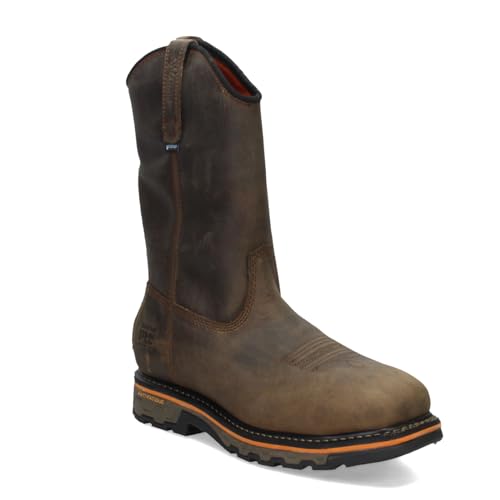
Best for: Wet industrial work and long shifts
The Timberland PRO True Grit is a pull-on western work boot for job sites that need toe protection and water resistance. This 8 M US model uses a lightweight, non-metallic CarbonShield composite toe. It meets ASTM F2412-18a and ASTM F2413-18 impact and compression standards, along with CAN/CSA-Z195-14 Grade 1 requirements. That makes it suitable for many industrial workplaces where steel toes are not preferred.
Its waterproof membrane adds protection in rain and wet work areas, while the Exospine structure helps support the shaft and heel. Inside, the Anti-Fatigue footbed uses shock-absorbing geometric sections to return energy with each step. The outsole is TPU, not traditional rubber, and is designed to resist oil, abrasion, and slipping on wet or frosted surfaces. Around $180, this boot costs more than basic pull-on work footwear. The trade-off is a safety-focused design with useful protection for changing outdoor conditions.
Pros
- Composite toe meets major ASTM impact and compression standards without metal.
- Waterproof membrane helps keep feet dry in wet work environments.
- TPU outsole adds oil, abrasion, and wet-surface traction.
Cons
- Pull-on construction provides less fit adjustment than lace-up boots.
- The protective toe and structured shaft may feel stiff during break-in.
2. KEEN Utility Evanston Pull-On Waterproof Boot

Best for: Flexible protection on demanding workdays
The KEEN Utility Evanston is a men’s pull-on work boot for buyers who want waterproof coverage without a traditional lace-up setup. This Bison/Black version uses a carbon-fiber safety toe in a round-toe shape, with side pull handles for getting the boots on. The listed size is 10 D, or medium width. A secure heel design helps keep the foot positioned during regular movement.
Protection is the main reason to consider this pair. It meets or exceeds ASTM F3445 requirements and ASTM F2413 M/I/75 and C/75 safety standards, according to the product specifications. The carbon-fiber toe may appeal to workers who prefer a nonmetal toe option, though the listing does not provide weight or clearance details. Waterproof construction suits wet job sites and outdoor chores, while the pull-on format may feel more flexible than a stiff boot. At around $135, it sits in the middle of work-boot pricing. The main compromise is fit adjustment. Side handles make entry easier, but there are no laces for fine-tuning tension across the foot. Check the size chart carefully, especially if you need a wide or narrow fit.
Pros
- Waterproof construction helps protect feet during wet work.
- Carbon-fiber toe meets listed impact and compression standards.
- Side pull handles make entry quicker than lacing.
Cons
- Pull-on design offers less fit adjustment than laced boots.
- This listing is size 10 D only, so other sizes require a separate search.
1. Timberland PRO True Grit Pull-On Composite Toe Work Boot

Best for: Western-style worksite protection
This pull-on work boot pairs a medium-brown leather-style western design with a non-metallic composite safety toe. The listed model is a men’s size 10 Wide, and it targets jobs that need protection from impact, compression, and wet conditions. The CarbonShield toe uses an asymmetrical shape to reduce bulk around the foot. It meets ASTM F2412-18a and ASTM F2413-18 I and C safety standards.
The waterproof membrane is rated to ASTM F1671-07, which adds protection for rainy workdays and damp job sites. Timberland’s Anti-Fatigue footbed uses geometric shock absorption to return energy underfoot, while the Exospine structure supports the heel and pull-on shaft. A hidden expansion seam also makes entry easier than many rigid western boots. Around $175, this is a mid-priced option for workers who want a traditional boot shape with modern safety features. Still, pull-on convenience comes with less fit adjustment than laces, and the tall shaft may feel restrictive for some ankles.
Pros
- Composite CarbonShield toe avoids metal while meeting impact and compression standards.
- Waterproof membrane adds protection in wet work areas.
- Anti-Fatigue cushioning helps reduce foot strain during long shifts.
Cons
- Pull-on construction offers less precise fit control than lace-up boots.
- The western shaft and safety toe may feel bulky during break-in.
Buying Guide
The most important factor is a verified safety rating, because a composite toe only protects properly when the boot meets recognized impact and compression standards. Look for ASTM F2413 protection and enough room for your toes to move without rubbing.
- Safety certification: Choose boots marked ASTM F2413-18 or a current equivalent, with impact, compression, and electrical-hazard protection when your job requires it. The label should appear on the boot, box, or manufacturer’s product page.
- Fit and toe space: Measure both feet late in the day, then leave about ⅜ to ½ inch beyond your longest toe. Pull-on shafts should hold the heel securely without pinching your calf or requiring force to remove the boot.
- Water resistance: For wet work, choose waterproof leather or a waterproof membrane, plus a gusseted tongue if the design has laces. A 10- to 12-inch shaft gives more protection than a low ankle boot.
- Sole traction and durability: Look for rubber outsoles with oil- and slip-resistant labeling, deep 4- to 6-millimeter lugs, and a heel suited to ladders or uneven ground. Replace worn tread before the grooves become shallow.
- Weight and price: Many composite-toe pull-ons cost about $100 to $220 per pair. Staying near 4 to 5 pounds per pair can reduce fatigue during eight- to 10-hour shifts.
If you cannot have everything, prioritize the verified safety rating and a secure, comfortable fit.
Frequently Asked Questions
How do composite toe pull-on work boots compare with steel toe boots?
Composite toe pull-on boots are lighter and less conductive than steel toe models, but they may offer less room and cost more. Composite caps use materials such as fiberglass, carbon fiber, or plastic, while steel uses metal. Both can meet ASTM F2413 impact and compression ratings, so check the label.
What makes a good composite toe pull-on work boot?
Look for a snug heel, enough toe room, a slip-resistant outsole, and an ASTM-rated composite safety toe when choosing pull-on work boots. Leave roughly 1/2 inch between your longest toe and the boot’s front. Waterproof leather, reinforced pull tabs, and removable insoles can also improve daily comfort.
Can composite toe pull-on boots handle construction work?
Yes, composite toe pull-on boots can handle construction, warehouse, and utility work when their safety ratings match the job hazards. Check for ASTM F2413 certification, plus labels for electrical hazard protection or slip resistance when needed. A safety toe protects against impact and compression, not every workplace danger.
Are composite toe pull-on boots good for cold weather?
Composite toe pull-on boots can suit cold-weather work, but insulation, waterproofing, and outsole traction matter more than the toe cap alone. Look for boots rated with about 200 to 400 grams of insulation for colder conditions. A waterproof membrane and deep tread also help when snow or slush covers the ground.
Conclusion
Timberland PRO True Grit Pull-On Composite Toe Work Boot is the top pick for workers who want slip-on convenience, composite-toe protection, and a durable boot for regular jobsite use. If your priority is lighter weight, waterproof coverage, or a lower price, choose the alternative that matches that need instead of paying for features you will not use. Before buying, double-check the size chart and fit notes, compatibility with your workplace’s safety rules, the package quantity, and the current price, since listings can change. Also consider your daily conditions, including mud, rain, ladders, concrete floors, and long periods on your feet. The right pair should protect your toes without making every shift harder.