
5 Best Work Gloves for Handling Wood for Carving
WZQH Leather Work Gloves is the top pick for most buyers among the best work gloves for handling wood because its leather construction offers a practical balance of abrasion protection and hand flexibility. It suits common jobs such as moving lumber, carrying firewood, cutting branches, and stacking boards without feeling like a bulky pair of heavy-duty gauntlets.
This guide is for homeowners, woodworkers, landscapers, and anyone who regularly handles rough boards, logs, or splintered scrap. For this type of glove, start with the fit and material: fingers should bend without excess fabric, while leather or reinforced panels should cover high-wear areas. Wrist coverage also matters around bark and splinters. The five picks below are ranked by their strengths, with clear reasons and honest drawbacks for each, so you can match protection and comfort to the job.
Quick Comparison
| # | Product | Best For | Price | |
|---|---|---|---|---|
| 1 | WZQH Leather Work Gloves | Outdoor chores and yard work | ~$10 | View → |
| 2 | Schwer ProGuard Cut-Resistant Work Gloves | High-risk cutting tasks | ~$15 | View → |
| 3 | WZQH Leather Work Gloves | General workshop hand protection | ~$10 | View → |
| 4 | Wells Lamont Leather Palm Work Gloves | Budget-friendly farm maintenance | ~$13 | View → |
| 5 | Schwer PM3401 Cut-Resistant Leather Work Gloves | Leather protection with cut resistance | ~$22 | View → |
5 Top Woodworking Gloves
These five picks are ranked by grip, protection, comfort, and durability, counting down to the top choice for handling wood.
5. Schwer PM3401 Cut-Resistant Leather Work Gloves
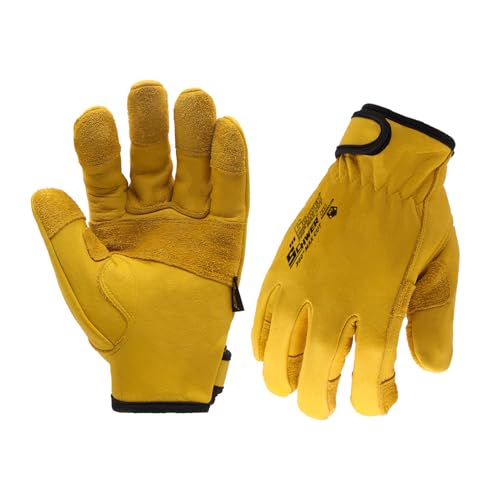
Best for: metalworkers handling sharp stock
The Schwer Pro Max PM3401 is a leather work glove with an ANSI/ISEA 105 A9 cut-resistant liner. This size L pair uses 100% full-grain cowhide, with extra leather across the palms and fingertips for added abrasion and puncture resistance. The inner knit liner protects against cuts from blades, sheet metal, and glass. The outer leather itself is not cut-resistant, so protection depends on the liner staying intact.
A hook-and-loop cuff lets you adjust the fit and helps keep dust and debris out. The thumb uses a wedge-shaped design for easier movement, while seams sit away from the palm to reduce pressure during extended work. These gloves suit mechanics, construction workers, carpenters, landscapers, and emergency responders. At around $22, they offer more protection than basic leather gloves, but the added liner may make size L feel tighter at first. Allow room for the liner and repeated wear.
Pros
- ANSI A9 liner provides a high level of cut protection for sharp materials.
- Full-grain cowhide with reinforced palms and fingertips resists abrasion and punctures.
- Adjustable cuff and offset seams support a secure, flexible fit.
Cons
- The leather exterior does not provide cut resistance on its own.
- The liner adds bulk, which may reduce fine finger control for small parts.
4. Wells Lamont Leather Palm Work Gloves

Best for: Heavy-duty yard and shop work
The Wells Lamont leather palm gloves use 100% cowhide leather across the glove. That material helps resist abrasion and punctures during tasks such as fencing, demolition, construction, and equipment operation. This version comes in Large, with a longer safety cuff that covers more of the wrist than a short garden glove. The cuff adds useful protection when handling rough lumber, tools, or wire.
A stretch section on the back of the hand helps keep the glove close to the wrist. That can reduce shifting during repetitive work. The design dates back to 1930, giving it a long history as a basic work glove style. At around $13, it is an inexpensive choice for homeowners, gardeners, and trade workers who need leather protection without buying specialized gloves. Still, its traditional build favors toughness over fine control. It fits best for handling materials and tools, not detailed assembly or touch-screen use.
Pros
- 100% cowhide leather helps resist everyday abrasion and punctures.
- The extended safety cuff gives the wrist more coverage.
- Elastic at the back helps limit slipping during work.
Cons
- Thick leather can reduce finger dexterity for small parts and precision tasks.
- The gloves are not described as waterproof, so wet work may shorten their useful life.
3. WZQH Leather Work Gloves

Best for: Thorny garden and heavy yard work
These WZQH work gloves use split cowhide leather with a soft cotton-fiber lining. A reinforced palm adds protection in high-contact areas, while the adjustable wrist helps keep dirt and small debris out. The gloves come in six sizes, from XS through 2XL, which gives more people a chance to find a workable fit. At around $10, they are a low-cost option for garden chores, moving firewood, farm tasks, construction, and general garage work.
Their strongest feature is coverage for rough outdoor jobs. The leather is designed to resist abrasion, punctures, cuts, and thorns from plants such as roses, blackberry bushes, and cacti. They can also suit welding, grinding, woodworking, and handling barbed wire, but the listing does not provide a specific heat rating. The cotton lining may feel more comfortable than unlined leather, though it can make the gloves warmer during long tasks. The coffee-gray finish hides some dirt better than lighter colors, but leather still needs proper drying after exposure to moisture.
Pros
- Split cowhide leather helps protect against thorns, scrapes, and rough materials.
- Reinforced palms add coverage for gripping tools, wood, and wire.
- Six available sizes, XS through 2XL, support a broader fit range.
Cons
- Thick leather and lining may reduce finger feel for fine tasks.
- The listing gives no exact temperature limit or waterproof rating.
2. Schwer ProGuard Cut-Resistant Work Gloves

Best for: glass handling and metal fabrication
These Schwer ProGuard gloves are knitted work gloves with an ANSI A9 cut-resistance rating, the highest level in the ANSI/ISEA 105 cut scale. The 13-gauge construction aims to balance protection with hand movement, while a sandy nitrile coating covers the palm and fingers for added grip. A reinforced thumb crotch targets one of the areas that often wears out first. The listing identifies this pair as size L, so buyers should check the available sizing before ordering. At around $15 per pair, they offer substantial protection without a high upfront cost.
The gloves also include touchscreen-compatible fingertips, which can help when checking a phone or tablet during a job. The knitted material should allow more airflow than thick leather gloves, though breathability will vary with the task and work environment. These are suited to carton handling, gardening, woodworking, automotive work, construction, and similar jobs involving sharp edges. Their A9 rating does not mean they protect against every workplace hazard. Punctures, heat, chemicals, and moving machinery require task-specific protection.
Pros
- ANSI A9 rating provides a high level of cut resistance.
- Sandy nitrile palms improve grip on wet or greasy surfaces.
- Reinforced thumb areas can reduce wear during repeated handling.
Cons
- The size L listing may not fit users with smaller or larger hands.
- Cut resistance does not replace protection from heat, punctures, or chemicals.
1. WZQH Leather Work Gloves
Best for: Thorny yard work and light welding
These WZQH work gloves use split cowhide leather with a soft cotton-fiber lining. The coffee-gray pair comes in six sizes, from XS through 2XL, and has an adjustable wrist closure to help keep soil, sawdust, and other small debris out. A reinforced palm adds protection where tools and rough materials create extra wear. The maker lists them for gardening, construction, farm chores, woodworking, driving, warehouse tasks, and welding. At around $10, they suit buyers who want one general-purpose pair at a low cost.
The strongest use case is outdoor handling. The leather is designed to resist punctures and thorns from roses, cactus, blackberry bushes, and similar plants. It also gives more protection than thin fabric gardening gloves when moving firewood, wire, rocks, or rough lumber. The lining should make longer chores more comfortable, while the flexible construction may help with basic tool handling. Still, these are protective work gloves, not precision mechanic gloves. The leather can limit fingertip feel, and the product page does not provide a heat rating or welding safety certification. Check the size chart carefully, since the listed measurements are taken by hand and may vary slightly.
Pros
- Split cowhide leather helps shield hands from abrasion, punctures, and thorns.
- Reinforced palms add protection for tools, firewood, wire, and rough lumber.
- Six sizes, XS to 2XL, offer more fitting options than a one-size pair.
Cons
- Thick leather will reduce fine fingertip control for small parts.
- No specific temperature rating or welding certification is listed.
Buying Guide
The most important factor is protection matched to the wood task. Moving smooth boards needs less coverage than splitting logs, handling rough bark, or pulling nails.
- Abrasion and puncture protection: Choose gloves rated EN 388 abrasion level 3 or 4 for rough lumber. A puncture rating of 3 or higher helps resist splinters and sharp wood edges.
- Fit and dexterity: Measure your palm around the widest point, then select a snug size with about ¼ inch of fingertip space. Loose fingers can reduce grip on boards and tools.
- Cuff and wrist coverage: Look for a 2- to 4-inch cuff when carrying logs or brush. A knit wrist works for indoor lumber, but it leaves more skin exposed.
- Material and grip: Leather palms handle dry wood well, while nitrile-coated palms provide better grip on damp boards. Textured coatings should cover the fingers, not only the palm.
- Weather and replacement cost: Pick insulated gloves for work below 45°F, but avoid thick lining when fine handling matters. A practical price range is $15 to $35 per pair, with two pairs useful for wet jobs.
If you cannot have every feature, prioritize a snug fit with abrasion and puncture protection.
Frequently Asked Questions
How should work gloves fit when handling wood?
Work gloves for wood handling should fit snugly at the fingers and wrist without restricting movement. Choose a pair with about 3 to 5 millimeters of fingertip space, not a loose palm that can catch on rough boards, saw handles, or nails. A secure cuff also keeps splinters and sawdust from entering.
What materials make gloves suitable for handling wood?
Leather and tough synthetic fabrics make suitable gloves for handling wood because they resist abrasion while allowing basic hand movement. Leather palms help with rough boards, while nylon or spandex backs improve flexibility; rubberized coatings can add grip when carrying smooth plywood or treated lumber. Choose based on the work and weather.
Can work gloves prevent splinters from wood?
Work gloves can reduce splinter injuries, but no pair can guarantee protection from every sharp fragment. Select a close-fitting leather or coated pair with intact seams, then inspect boards for nails and broken edges before lifting them. Replace gloves when holes appear or the palm becomes thin.
Do thicker work gloves protect hands better from rough lumber?
Thicker work gloves usually provide more abrasion and impact protection, but they can reduce dexterity and grip. A glove with reinforced palms and padded knuckles suits heavy handling, while a thinner pair works better for sorting kindling or using small hand tools. Check that the extra padding does not limit finger movement.
Conclusion
WZQH Leather Work Gloves are the top recommendation for people who want a practical pair for splitting, stacking, and moving firewood without paying for features they may not use. The leather should suit routine handling, but thick material can limit finger movement and does not automatically provide certified cut or puncture protection. If cut resistance is your main priority, choose the roundup’s cut-rated alternative instead, because it better matches saw work and rough materials. Before buying, double-check the size chart, tool compatibility, package quantity, and current price, since listings and bundle details can change. A secure fit matters as much as sturdy material, especially when gripping rough lumber or using hand tools for long periods.