
5 Best Public Safety Drones for Emergency Response
For most buyers, the Autel Robotics EVO II Dual 640T V3 Thermal Drone is the top pick among the best public safety drones. Its main advantage is the dual-camera setup, which combines thermal imaging with a standard camera to help crews locate people, hot spots, and hazards in changing conditions. It offers a practical mix of search, inspection, and incident-response tools.
This guide is for fire departments, search-and-rescue teams, police agencies, and other public-safety groups comparing aerial equipment. Battery life and thermal image resolution matter most, since short flights can limit coverage and unclear heat signatures can slow decisions. Size also affects transport and launch speed at active scenes. The five picks below are ranked with clear reasons and honest drawbacks for each.
Quick Comparison
| # | Product | Best For | Price | |
|---|---|---|---|---|
| 1 | Autel Robotics EVO II Dual 640T V3 Thermal Drone | Search-and-rescue thermal teams | ~$4099 | View → |
| 2 | Firehouse Technology DJI Avata V2 Tactical Spotlight Kit | Tactical FPV night operators | ~$169 | View → |
| 3 | DJI Zenmuse S1 Spotlight | Matrice crews needing focused illumination | ~$1720 | View → |
| 4 | Autel Robotics EVO II Pro Enterprise V3 Drone | Enterprise mapping and inspection crews | ~$2999 | View → |
| 5 | DJI Mavic 3T/3E Spotlight with Speaker | Remote security teams needing announcements | ~$759 | View → |
5 Top Public Safety Drone Picks
These public safety drones are ranked by key features, flight needs, and agency value, counting down to our top pick.
5. DJI Mavic 3T/3E Spotlight with Speaker

Best for: DJI Mavic 3 rescue teams
This attachment combines a 30W spotlight with a 114dB speaker for the DJI Mavic 3T and 3E. Its 14-degree beam is listed for illumination up to 150 meters, while the audio system can broadcast up to 300 meters. It draws power from the drone, so no separate battery is required. At around $759, it targets professional search, rescue, and public-safety users rather than casual pilots.
The unit adds five flashing colors, red, blue, yellow, green, and white, with adjustable brightness and flash frequency. Its gimbal tilts from 0 to -90 degrees, allowing pilots to aim the light as the aircraft moves. Pilot 2 control supports light and gimbal adjustments, while text-to-speech playback covers Chinese, English, and local dialects. That mix of lighting, announcements, and remote aiming gives the accessory more utility than a basic drone lamp. Still, the listed range depends on conditions, background noise, and the drone’s position.
Pros
- 30W spotlight reaches a listed 150-meter lighting range.
- 114dB speaker supports broadcasts up to 300 meters.
- Five colors, adjustable flashing, and a -90-degree gimbal support signaling.
Cons
- IP54 protection helps against dust and splashes, but it is not waterproof for heavy rain or immersion.
- Around $759 is a substantial cost, and it only fits DJI Mavic 3T and 3E aircraft.
4. Autel Robotics EVO II Pro Enterprise V3 Drone
Best for: Public safety and inspection teams
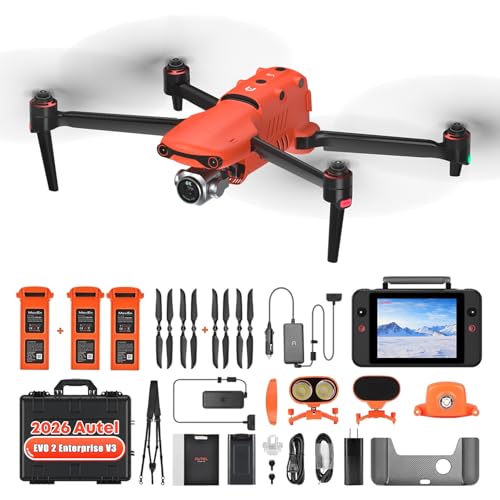
The Autel Robotics EVO II Pro Enterprise V3 is a professional camera drone priced around $2,999. Its 1-inch CMOS sensor captures 50MP still images, while the Moonlight Algorithm 2.0 is designed to reduce noise in dim conditions. The aircraft uses 19 sensors, including 12 visual sensors, for obstacle detection and route planning. It is rated for operation from -10°C to 40°C.
The package includes a 7.9-inch Smart Controller V3, three batteries, four pairs of propellers, a rugged case, and chargers for wall and vehicle use. Autel rates flight time at up to 42 minutes per battery, though payload, weather, and flight style affect that figure. SkyLink 2.0 supports transmission distances up to 15 km and uses 2.4GHz, 5.8GHz, and 900MHz bands. The included strobe, spotlight, and loudspeaker support rescue, inspection, traffic, and emergency work. RTK is optional and not included. The price also makes this a serious investment.
Pros
- 50MP camera and 1-inch sensor support detailed inspection images.
- Three batteries provide more flight coverage between charging sessions.
- Spotlight, strobe, and loudspeaker expand its emergency-use options.
Cons
- Around $2,999, it costs far more than consumer camera drones.
- RTK mapping capability requires a separate accessory, and the 42-minute rating is only an upper limit.
3. DJI Zenmuse S1 Spotlight

Best for: Nighttime inspection and search crews
The DJI Zenmuse S1 Spotlight is a dedicated lighting payload for the Matrice 300 RTK, 350 RTK, and 400 drone platforms. Its 68W output supports three modes: Low Beam, High Beam, and Both On. In Both On mode, DJI rates it at up to 35 lux from 328 feet, with an effective illumination distance reaching 1,640 feet in suitable conditions. Brightness and mode changes can be controlled from the remote controller, with customizable buttons for quicker access during a mission.
A three-axis gimbal keeps the beam aimed steadily as the aircraft hovers or moves. DJI lists angular vibration at ±0.01° in hover and ±0.02° in flight, which should help keep light on a person, structure, or inspection area. LED and LEP temperature protection, overcurrent protection, and power protection add useful safeguards during demanding work. At around $1,720, this is a specialized accessory for professional drone operations, not a casual add-on.
Pros
- 68W output provides useful illumination for low-light inspections and searches.
- Three lighting modes support close work and longer-distance visibility.
- Three-axis stabilization helps keep the beam directed during flight.
Cons
- Compatibility is limited to the Matrice 300 RTK, 350 RTK, and 400 platforms.
- Around $1,720 makes it a costly purchase for occasional nighttime missions.
2. Firehouse Technology DJI Avata V2 Tactical Spotlight Kit

Best for: DJI Avata 2 interior flight crews
The Firehouse Technology Tactical Spotlight Kit adds four lights to the DJI Avata 2. Two forward-facing spotlights help the camera see through dark interiors, while two downward lights support positioning near floors and obstacles. The full kit includes top and bottom mounts with screw-lock fasteners. Its combined output reaches 1,000 lumens, which can help in GPS-limited spaces where visual references matter more.
The low-profile layout keeps the lights within the drone’s airframe, so the setup is less likely to catch on tight passages. Firehouse lists about two hours of sports-mode runtime for the forward lights and roughly 50 minutes for the downward pair. All four units recharge through USB-C and use sealed, water- and dust-proof cases. You can also remove the lights for use on compatible drones during night work. At around $169, this is a specialized upgrade rather than a casual accessory. Firehouse says public safety and commercial teams use the system, but buyers should still confirm mount and flight rules for their work.
Pros
- Four-light layout improves forward visibility and downward positioning.
- Low-profile screw-lock mounts protect the lights within the Avata 2 frame.
- Removable USB-C rechargeable lights can support other drone setups.
Cons
- The downward lights run for only about 50 minutes per charge.
- This kit is designed for the Avata 2, so compatibility with other drones may require separate mounts.
1. Autel Robotics EVO II Dual 640T V3 Thermal Drone

Best for: Professional thermal inspection teams
The Autel Robotics EVO II Dual 640T V3 combines a thermal camera and visible-light camera in one Remote ID drone. Its thermal sensor records 640×512 video at 30 frames per second, with a 13mm lens, 16x digital zoom, and subject recognition listed up to 100 meters. The visible camera uses a 0.8-inch CMOS sensor with 50MP stills, 4x lossless zoom, and 16x digital zoom.
For inspection work, the aircraft offers spot, center, and area temperature readings, 10 thermal palettes, picture-in-picture viewing, alarms, and isotherm tools. Its 19 sensor groups include 12 visual sensors for mapping and flight assistance. Autel rates flight time at 38 minutes. SkyLink 2.0 supports 2.4GHz, 5.8GHz, and 900MHz connections, with video transmission listed up to 15km and image quality up to 2.7K. The bundle includes three batteries, a Smart Controller V3, chargers, spare propellers, and two protective cases. At around $4,100, it targets commercial users rather than casual pilots.
Pros
- 640×512 thermal video provides more detail for roof, utility, and equipment inspections.
- Three batteries can support longer field sessions than a single-battery kit.
- Temperature alarms, measurement modes, and picture-in-picture tools aid faster assessments.
Cons
- Around $4,100 is a major investment for occasional or recreational flying.
- The listed 15km transmission range depends on line of sight, local rules, interference, and terrain.
Buying Guide
Mission-specific sensor capability matters most when choosing a public-safety aircraft. A thermal camera can locate a person at night, while a high-resolution daylight camera suits traffic scenes and evidence capture.
- Sensor package: Choose at least a 4K daylight camera with a three-axis gimbal, and consider 640×512 thermal resolution for search-and-rescue work. Radiometric thermal sensors cost more but can record temperature data.
- Flight time: Look for 30–45 minutes of rated flight time per battery, then buy three batteries for repeated callouts. Cold weather, wind, and payloads reduce that rating.
- Weather protection: An IP54 rating protects against dust and light rain, while IP55 or higher fits wetter operations. Confirm the stated wind rating reaches at least 25 mph.
- Control link: Require encrypted video, Remote ID support, and a reliable range of at least 3 miles in open conditions. A cellular backup can help around buildings and hills.
- Compliance and support: Confirm FAA requirements, local procurement rules, data-storage location, and available parts. Set aside roughly $1,000–$5,000 for training, batteries, software, and repairs beyond the aircraft price.
If funds force a compromise, prioritize the sensor package that matches the agency’s most common mission.
Frequently Asked Questions
How do public safety teams choose the right drone?
Public safety teams should choose a drone based on flight time, camera needs, weather rating, training, and local rules. A thermal camera helps locate people at night, while optical zoom supports searches from a safer distance. Look for at least 30 minutes of flight time and spare batteries for repeated missions.
What features matter most in a public safety drone?
Useful features include thermal imaging, obstacle avoidance, night flight support, encrypted video, and accurate location data. A model with a 640 × 512 thermal sensor can reveal heat sources more clearly than a basic visible-light camera, but image quality varies. A strobe, speaker, and return-to-home function also support searches and evacuations.
Can public safety drones be used indoors?
Yes, some public safety quadcopters can operate indoors, but only models with protected propellers, precise positioning, and trained pilots should be considered. GPS often fails inside buildings, so optical sensors or LiDAR help maintain control. Compact aircraft under 1 kilogram fit tighter spaces, while a loudspeaker can communicate with occupants.
Are public safety drone flights legally allowed?
Yes, public agencies can use drones legally, but flight rules, pilot credentials, privacy laws, and evidence policies vary by location. In the United States, many operations fall under FAA Part 107, while public aircraft may follow different approval paths. Agencies should document training, warrant requirements, data retention, and airspace checks.
Conclusion
The Autel Robotics EVO II Dual 640T V3 Thermal Drone is the strongest fit for public safety teams that need thermal imaging for search operations, inspections, and nighttime situational awareness. If your priority is easier transport or lower cost, choose a smaller standard-camera drone instead, since it may fit routine patrols and quick launches better than a thermal aircraft. Before buying, double-check the aircraft’s folded and operating size, compatibility with your controller, software, batteries, and accessories, the quantity your team needs, and the current price from an authorized seller, then verify local flight rules, operator training, thermal-data handling, and replacement-part access. Those details can affect daily operations as much as the aircraft itself.