
6 Best Road Bike Tire Pressure Gauge for Racing
JACO RDX-160 Presta Tire Pressure Gauge is the best road bike tire pressure gauge for most buyers because its large analog dial makes quick pressure checks easy to read. This compact, Presta-focused tool suits riders who want a simple reading before a ride, rather than a full pump-and-gauge setup. Its straightforward design keeps the process focused: connect it, read the dial, and adjust your tire with a separate pump.
This guide is for road cyclists, commuters, racers, and home mechanics who want more consistent tire pressure without carrying bulky workshop equipment. For this type of gauge, the key factors are readable pressure markings, a secure Presta connection, manageable size, and a pressure range that fits road tires. The six picks below are ranked by those details, with clear reasons and honest drawbacks for each. That makes it easier to choose a gauge that fits your bike, storage space, and maintenance routine.
Quick Comparison
| # | Product | Best For | Price | |
|---|---|---|---|---|
| 1 | JACO RDX-160 Presta Tire Pressure Gauge | Road cyclists needing precision | ~$23 | View → |
| 2 | GODESON Presta Valve Bicycle Tire Pressure Gauge | Budget-conscious Presta valve users | ~$11 | View → |
| 3 | Topeak SmartGauge D2 Digital Tire Pressure Gauge | Digital pressure readout seekers | ~$35 | View → |
| 4 | JACO BikePro Bike Tire Pressure Gauge | Mountain bikers checking tire pressure | ~$26 | View → |
| 5 | BV High-Pressure Bike Pump with Gauge | Riders needing pump and gauge | ~$24 | View → |
| 6 | Floor Bike Pump with Gauge, Presta & Schrader Valves | Mixed-valve household bike owners | ~$16 | View → |
6 Road Bike Pressure Gauges Worth Considering
The list is ranked by accuracy, valve compatibility, and ease of use, counting down to the top pick.
6. Floor Bike Pump with Gauge, Presta & Schrader Valves

Best for: Home cyclists with mixed valves
This floor bicycle pump is designed for road, mountain, and everyday bikes. Its dual-valve head supports both Presta and Schrader valves, so most riders will not need a separate adapter for tire inflation. A foldable footrest helps keep the base steady during use, while the 2-inch dial shows pressure readings up to the listed 160 PSI limit. At around $16, it targets riders who want one pump for regular tire checks without spending much.
The strongest feature is its built-in accessory storage. The handle and storage compartment hold a needle, cone, and ball adapter, keeping the three pieces with the pump instead of loose in a drawer. An angle adapter is also included for awkward valve positions on strollers and other inflatables. That makes this more useful around the house than a bike-only pump. Still, the product details do not state the hose length, gauge tolerance, or construction materials. Those omissions make it difficult to judge long-term durability or high-pressure accuracy from the listing alone.
Pros
- Works with both Presta and Schrader valves.
- Includes three adapters for balls, cones, and inflatables.
- 2-inch gauge displays pressure up to 160 PSI.
Cons
- The listing does not provide gauge accuracy or hose-length details.
- A floor pump is less convenient to carry on rides than a compact mini pump.
5. BV High-Pressure Bike Pump with Gauge

Best for: Road cyclists and family bikes
This floor-style bicycle pump uses a durable steel body and reaches up to 160 PSI. Its 16.25-inch length keeps it manageable for home storage or trips in a vehicle. The ergonomic handle gives your hands a broader grip than a small emergency pump, which helps during longer inflation jobs. At around $24, it targets riders who want a metal pump without paying for a workshop-grade model.
The valve head supports both Presta and Schrader tires. To change formats, you reverse the internal components instead of carrying a separate adapter. That design keeps the setup compact, although it is not a one-switch automatic change. A built-in pressure gauge helps you monitor inflation, and the pump is also listed for balls. The product description references a “17/24-inch” smart valve head, but that measurement is not clearly explained and conflicts with the stated 16.25-inch pump length. Buyers should confirm the listing details before ordering.
Pros
- Steel construction should handle regular home use better than many lightweight plastic pumps.
- The 160 PSI rating suits road-bike tires and other high-pressure inflation jobs.
- Reversible valve parts support both Presta and Schrader tubes.
Cons
- Reversing the valve components takes more effort than using a true dual-head design.
- Steel construction may make it heavier to carry than compact plastic pumps.
4. JACO BikePro Bike Tire Pressure Gauge

Best for: Road cyclists checking tire pressure
The JACO BikePro is an analog tire pressure gauge for bicycles, cars, trucks, and SUVs. Its 2-inch glow-in-the-dark dial reads from 0 to 160 PSI, or 0 to 11 BAR, so it covers high-pressure road tires and everyday vehicle tires. The needle stays in place after measurement, which makes the reading easier to record before pressing the reset button.
Its strongest feature is valve flexibility. Interchangeable chucks fit both Presta and Schrader stems, while the flexible hybrid hose can reach valves between closely spaced spokes. A built-in bleeder releases excess air when a tire is overfilled. The gauge uses a solid brass body with a gear-style protective guard, giving it a more durable design than small plastic tire gauges. JACO lists calibration to ANSI standards within ±1.5%, based on testing at a NIST-certified facility. Around $26, it costs more than basic pencil gauges but does not need batteries.
Pros
- Covers Presta and Schrader valves with interchangeable chucks.
- Measures up to 160 PSI, suitable for road bike tires and vehicles.
- Bleeder valve lowers pressure without removing the gauge.
Cons
- The analog needle can be harder to read precisely than a digital display.
- Switching or storing separate chucks adds an extra step to quick pressure checks.
3. Topeak SmartGauge D2 Digital Tire Pressure Gauge

Best for: Cyclists tuning tire pressure precisely
The Topeak SmartGauge D2 is a compact digital pressure reader for bike tires, motorcycle tires, suspension forks, rear shocks, and sports equipment. Its rotating SmartHead accepts both Presta and Schrader valves without a separate adapter. It reads as high as 250 psi, or 17 bar, and the LCD can show psi, bar, or kg/cm². A pressure-release button lets you remove small amounts of air when a tire or shock is slightly overfilled.
This gauge measures 10.2 x 4.5 x 3.5 cm and weighs 65 g, so it fits easily in a tool kit or travel bag. The engineering-grade polymer body keeps the format light, while the 360-degree rotating head helps when valve access is awkward. One CR2032 battery comes included, so it is ready for setup after purchase. At around $35, it costs more than a basic analog gauge. The digital readout and 250-psi range make it more useful for riders who adjust pressures often.
Pros
- Works with both Presta and Schrader valves through one rotating head.
- Measures pressures up to 250 psi, or 17 bar.
- Shows readings in psi, bar, or kg/cm² on the LCD.
Cons
- It needs a CR2032 battery, which will eventually require replacement.
- It only measures and releases air, so you still need a separate pump.
2. GODESON Presta Valve Bicycle Tire Pressure Gauge
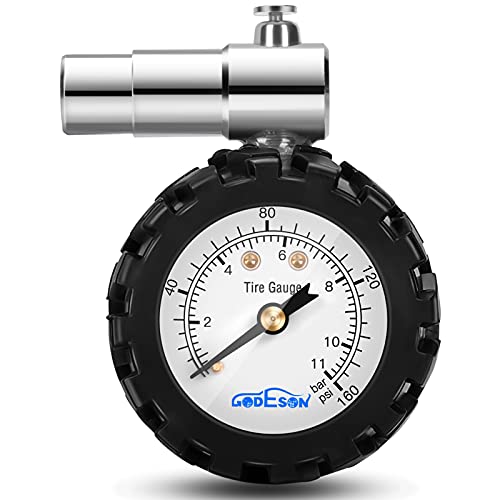
Best for: Road cyclists carrying minimal tools
The GODESON Presta Valve Bicycle Tire Pressure Gauge is a compact, mechanical reader for bicycles with Presta valves. Its Bourdon tube design needs no batteries, making it useful in a saddle pack, handlebar bag, or home repair kit. The gauge covers 0 to 160 psi and 0 to 11 bar, so riders can use either the imperial or metric scale.
A 1.5-inch dial gives the pressure reading at a glance, though its small size may not suit riders with poor eyesight. The dedicated chuck has a clamp that must sit tightly on the valve stem, with the gauge held in line with the stem during a reading. That setup matters more than it might with a flexible hose. A built-in air-release button allows small pressure adjustments or a full reset after checking. At around $11, it offers a low-cost way to carry a pressure reference without adding batteries or much bulk. Its main limitation is compatibility. This gauge is made for Presta valves, not Schrader valves found on some bikes and inflators.
Pros
- Covers 0–160 psi and 0–11 bar on one dial.
- Mechanical Bourdon tube works without batteries.
- Compact body fits many handlebar or seat packs.
Cons
- Presta-only design may require an adapter for Schrader valves.
- The 1.5-inch dial can be harder to read in low light or for users with limited vision.
1. JACO RDX-160 Presta Tire Pressure Gauge

Best for: Road cyclists with Presta valves
The JACO RDX-160 is a compact, analog tire pressure gauge for high-pressure bike tires. It reads from 10 to 160 PSI and works without batteries. The gauge is designed for Presta valves only, so it will not fit Schrader valves found on many wider tires. At around $23, it costs more than basic pen-style gauges but adds useful control for road riding.
Its 2-inch glow-in-the-dark dial should be easier to read in dim conditions, while the needle stays at the measured pressure until you press the reset button. A built-in bleeder valve lets you release small amounts of air instead of removing the pump and guessing. The 90-degree nozzle can fit between spokes, and the rubberized cover helps protect the gauge from bumps. The unit comes with a hard-shell zip case for storage. JACO lists calibration to ANSI B40.1 standards with 1.5% mid-scale accuracy, plus a lifetime warranty for performance issues in the United States and Canada.
Pros
- Covers high-pressure road tires with a 10-160 PSI range.
- Built-in bleeder valve allows fine pressure adjustments.
- Includes a protective hard-shell case for tool bags.
Cons
- Presta-only design excludes Schrader valves without an adapter.
- Analog readings may be slower to interpret than a digital gauge.
Buying Guide
The most important factor is accuracy across your normal pressure range. Road tires often need 70 to 110 psi, so a gauge accurate within ±1 psi can help prevent harsh rides, poor grip, and pinch flats.
- Pressure range: Choose a model rated to at least 160 psi, even if your tires need less. This leaves room for high-pressure tires and prevents readings near the gauge’s limit.
- Accuracy and resolution: Look for stated accuracy of ±1 to 2 psi and 1 psi increments. Avoid gauges that display only 5 or 10 psi steps.
- Valve compatibility: Select a Presta-compatible head, or a dual-head design for Presta and Schrader valves. A locking chuck should stay attached without hand pressure.
- Display and readability: Digital screens work well in dim garages, while a 2 to 3-inch analog dial needs no batteries. Backlighting helps during roadside adjustments.
- Size and cost: A pocket model under 8 inches fits most saddlebags. Expect to pay $15 to $40 for a reliable gauge with replaceable batteries or hose parts.
If you cannot have everything, prioritize accurate readings at your usual tire pressure.
Frequently Asked Questions
How accurate should a road bike tire pressure gauge be?
Look for accuracy within about 0.5 psi, a clear display, and compatibility with your valve type when choosing a road-bike pressure gauge. Most quality digital models claim readings within ±1% or 0.5 psi, but calibration matters more than a bright screen. Pick one with a lockable chuck and a replaceable battery.
What pressure range should a road bike tire gauge cover?
A road bike tire pressure gauge should cover at least 0 to 160 psi, with fine increments near your normal riding pressure. Many tires run between 70 and 100 psi, depending on rider weight, tire width, and tubeless setup. A 0.5 psi resolution gives more useful adjustments than a 5 psi analog scale.
Can a digital tire gauge improve road bike setup?
Yes, a digital tire gauge can be better for road bikes because it usually reads small pressure changes more clearly. A model showing 0.1 or 0.5 psi increments helps when tuning tires around 80 psi. Analog gauges avoid batteries, though their needles can be harder to read in low light.
Are compact tire pressure gauges good for roadside use?
Yes, compact gauges are useful for roadside pressure checks, but they should not replace a full-size pump gauge at home. A pocket model under 200 grams fits most saddle bags, while a separate floor pump can inflate tires faster. Check that the small tool accepts Presta valves without an adapter.
Conclusion
JACO RDX-160 Presta Tire Pressure Gauge is the top choice for road cyclists who want accurate pressure checks from a straightforward analog tool. If portability matters more than a larger dial, pick the compact digital option from the roundup instead, since it can fit more easily in a saddlebag or jersey pocket. Before buying, double-check the gauge’s size, Presta valve compatibility, package quantity, and current price, since listings and bundles can change. Also consider your target pressure range and how often you ride. A durable gauge makes routine checks easier, but the right fit depends on your valve type, storage space, and preferred display. For most home workshops, the JACO offers the strongest balance of clarity, simplicity, and value.