
7 Best Freeze Alarm for Homeowners
The GoveeLife WiFi Refrigerator Thermometer Sensor is the best freeze alarm for most buyers because it can send temperature alerts to a phone over Wi-Fi. It is designed for refrigerators and freezers, so it suits shoppers who want remote monitoring instead of relying on a local siren alone. The app also makes temperature history easier to review, which can help spot repeated swings before food spoils.
This guide is for homeowners, renters, and anyone protecting food, medication, or other temperature-sensitive items during outages or equipment problems. The key factors are alert reliability, sensor placement, battery life, and the distance between the appliance and your Wi-Fi router. A compact probe also matters when shelf space is tight. The seven picks below are ranked by their strengths, with clear reasons and honest drawbacks for each, so you can choose the right temperature monitor for your freezer or refrigerator.
Quick Comparison
| # | Product | Best For | Price | |
|---|---|---|---|---|
| 1 | GoveeLife WiFi Refrigerator Thermometer Sensor | Smart-home temperature monitoring | ~$34 | View → |
| 2 | AcuRite 00515M Wireless Fridge Freezer Thermometer Alarm | Budget alarm-conscious households | ~$40 | View → |
| 3 | MOCREO WiFi Thermometer Freezer Alarm | Remote freezer owners | ~$50 | View → |
| 4 | FRIDGGI Freezer Door Alarm | Door-left-open reminders | ~$18 | View → |
| 5 | GoveeLife WiFi Refrigerator Thermometer Sensor | App-connected food storage | ~$25 | View → |
| 6 | Freezer Power Failure Alarm | Outage-prone home freezers | ~$24 | View → |
| 7 | Wireless Fridge Freezer Thermometer with Alarm | Shared kitchen temperature checks | ~$19 | View → |
7 Top Freeze Alarm Picks
These freeze alarms are ranked from seventh to first, counting down to the top pick.
7. Wireless Fridge Freezer Thermometer with Alarm

Best for: monitoring household fridges and freezers
This wireless thermometer tracks temperature and humidity in two locations at once. The package includes two sensors, and the stated wireless range reaches up to 330 feet, or 100 meters. Readings update every 30 seconds, so you can check a refrigerator or deep freezer without opening the door. The sensors cover temperatures from -58°F to 158°F and humidity from 20% to 95%. Accuracy is rated at ±1.8°F for temperature and ±5% for humidity.
Its two customizable alerts are the main draw. You can set separate limits for the fridge and freezer, then receive an alarm when either reading leaves its range. The alarm sounds for up to one minute at a claimed 90 decibels. The display shows current readings, comfort status, trend arrows, and 24-hour high and low records. Battery power keeps it portable, while the included USB cable supports a constant backlight with high, low, or off settings. Batteries are not included. At around $19, it offers useful coverage for the price.
Pros
- Two sensors monitor a fridge and freezer simultaneously.
- Alerts can be set separately for each location.
- USB power provides an always-on, adjustable backlight.
Cons
- Batteries are not included, so portable use requires an extra purchase.
- The 330-foot range may be shorter indoors because walls and appliances can interfere.
6. Freezer Power Failure Alarm

Best for: Freezers in outage-prone homes
This plug-through alarm detects a power loss at a freezer, refrigerator, furnace, aquarium, or sump pump. It immediately combines a 110 dB siren with a flashing LED for 60 seconds. The built-in rechargeable battery avoids disposable battery replacements. An extended socket lets you plug the appliance directly into the alarm, so it does not take away a separate wall outlet.
After the first alert, the unit switches to LED-only flashes for one minute, followed by 10 seconds of sound and flashing. That pattern repeats for up to 12 hours, according to the listed specifications, or until the battery runs out. Seven sirens and five volume settings offer more control, including a 0 dB mute setting with light-only alerts. The alarm stops when power returns, or you can press the cancel button. At around $24, it offers useful coverage for basic home appliances without requiring an app or monthly fee.
Pros
- 110 dB sound and LED flashes can draw attention quickly.
- Seven sirens and five volume levels suit different rooms and noise levels.
- The pass-through socket keeps the appliance connected without using an extra outlet.
Cons
- The rechargeable battery eventually runs out during a long outage, with alerts listed for up to 12 hours.
- The loudest setting may be unpleasant in small rooms, while mute mode relies only on the LED.
5. GoveeLife WiFi Refrigerator Thermometer Sensor
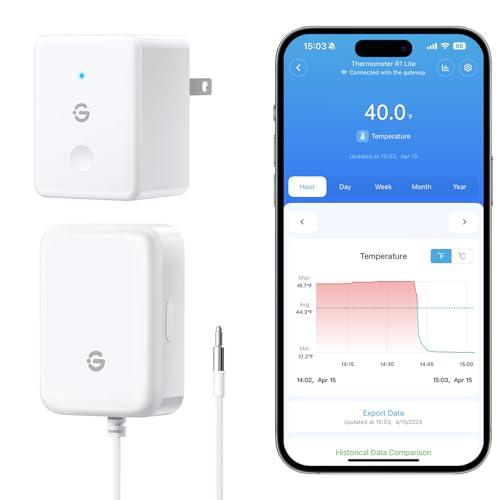
Best for: Homeowners monitoring one refrigerator
The GoveeLife WiFi Refrigerator Thermometer includes one temperature sensor and a gateway for remote monitoring. It tracks temperatures from -40°F to 158°F, with stated accuracy of ±0.9°F and readings that respond within two seconds. The 2.7mm NTC probe fits inside a refrigerator or freezer, while the main unit can hang or attach magnetically. At around $25, it offers more control than a basic display thermometer.
Alerts can arrive through the app or email, and the built-in buzzer reaches 80dB when temperatures leave your chosen range. The gateway supports up to 10 sensors across a claimed 230-foot range, so one system can cover several food-storage areas or rooms. Setup includes a probe holder for tidier cable placement and should take about five minutes. The sensor still works as a local monitor, but its remote features make the gateway the key part of the package.
Pros
- App, email, and buzzer alerts provide three ways to catch unsafe temperature changes.
- ±0.9°F accuracy and two-second response suit freezer and refrigerator monitoring.
- One gateway can support up to 10 sensors for multiple locations.
Cons
- The 230-foot range can drop with walls, appliances, and other obstructions.
- The 80dB alarm must be muted or silenced with the side button, which may become inconvenient during repeated alerts.
4. FRIDGGI Freezer Door Alarm

Best for: Busy households with forgetful door users
FRIDGGI is a compact white alarm for refrigerator and freezer doors. It uses a small alarm unit and mini sensor, which fit on newer or older appliances without taking up much space. The system starts with a two-second alert after one minute of continuous opening. If the door remains open, a four-second warning follows at two minutes. At three minutes, it sounds for 60 seconds to prompt a quick check.
Four sound settings cover different rooms and noise levels. Low mode reaches 80 dB, while Medium reaches 85 dB and Normal reaches 90 dB with a beep every 10 seconds. Loud mode uses 95 dB beeps, plus a 110 dB siren every four minutes for 20 seconds. The SET button activates that extra siren. Around $18, it costs less than many larger door-alert systems. Before applying the included double-sided tape, open and close the door to confirm the sensor gap works correctly.
Pros
- Staged alerts provide warnings before the longer 60-second alarm.
- Four volume options suit kitchens, garages, and utility rooms.
- Compact construction keeps the alarm less noticeable on the appliance.
Cons
- The 110 dB setting may disturb sleeping household members or nearby neighbors.
- The listing does not provide battery-life estimates, so ongoing replacement costs are unclear.
3. MOCREO WiFi Thermometer Freezer Alarm

Best for: Freezer owners needing remote alerts
The MOCREO WiFi Thermometer Freezer Alarm combines a Wi-Fi hub with two wireless temperature sensors. It monitors refrigerators, freezers, hot tubs, and other spaces from a phone. The sensors cover -40°F to 158°F with claimed accuracy of ±0.9°F. Their 0.9mm flat cables fit through many door seals, while magnetic backs, mounting plates, clips, and cable organizers support cleaner installation. The system costs around $50, though prices can change.
Its strongest feature is alert flexibility. You can receive app notifications, email alerts, or a 90dB hub alarm when temperatures move outside your chosen limits. The app can also mute the hub remotely, which is useful when the alarm sounds at night. Power loss, hub disconnection, and low battery conditions receive separate warnings. Data stays available for up to two years, with graph viewing and CSV export at no subscription cost. The H6Lite hub supports 2.4GHz Wi-Fi and can connect with up to 30 compatible MOCREO BLE sensors within a stated 230-foot range. Each sensor uses three replaceable AAA batteries, rated for up to two years.
Pros
- Sends app, email, and audible alerts for temperature problems.
- Stores two years of readings and supports CSV export.
- Two sensors monitor separate appliances or locations at once.
Cons
- Wi-Fi setup supports 2.4GHz networks only, not 5GHz.
- The stated 230-foot sensor range can vary with walls and interference.
2. AcuRite 00515M Wireless Fridge Freezer Thermometer Alarm

Best for: Monitoring a home refrigerator and freezer
The AcuRite 00515M is a wireless two-sensor thermometer set for tracking refrigerator and freezer temperatures from one digital display. Each sensor sends readings to the LCD unit, so you can check both compartments without opening either door. Custom temperature alarms can warn you about a door left open or a possible appliance problem. At around $40, it costs more than a basic single-compartment thermometer, but it covers two appliances at once.
The display gives you several placement choices. Its magnetic backing attaches to a refrigerator door, the keyhole supports wall mounting, and the foldout stand works on a counter. Each sensor uses a silicone strap and can hang from an included suction cup or wrap around a wire shelf. That flexibility helps in crowded compartments. The stainless steel finish also looks more polished than many plastic thermometers. Still, this is a monitoring tool, not a device that changes temperature or fixes a failing appliance.
Pros
- Two wireless sensors monitor the refrigerator and freezer separately.
- Adjustable alarms can flag temperature spikes from an open door or appliance trouble.
- Magnetic, wall, and countertop mounting options suit different kitchen layouts.
Cons
- One display handles both sensor readings, so it may be less convenient than having separate screens.
- Suction cups and silicone straps may not fit every shelf shape or compartment layout.
1. GoveeLife WiFi Refrigerator Thermometer Sensor

Best for: Monitoring multiple food storage areas
The GoveeLife WiFi Refrigerator Thermometer Sensor package includes two probe-based sensors and a gateway for remote monitoring. Each sensor uses a 2.7mm NTC probe, measures from -40°F to 158°F, and responds in about two seconds. Its rated accuracy is ±0.9°F, or ±0.5°C, which suits refrigerators, freezers, and other temperature-sensitive spaces. The magnetic or hanging setup and included probe holder help keep each cable organized.
When a reading leaves your chosen range, the system can send an app notification, email, and 80dB buzzer alert. The local alarm requires a side-button press to stop, though you can mute the buzzer. The gateway supports up to 10 sensors across a stated 230-foot range, so one hub can cover several rooms or appliances. Setup should take about five minutes. At around $34, this package offers useful coverage for households protecting frozen and refrigerated food. Remote alerts depend on the gateway, WiFi connection, and app access.
Pros
- Two sensors monitor separate refrigerators, freezers, or rooms from one gateway.
- The 2.7mm probe responds in about two seconds across a -40°F to 158°F range.
- App, email, and 80dB buzzer alerts provide several warning options.
Cons
- The gateway’s 230-foot range can shrink indoors because of walls and interference.
- The loud alarm must be stopped with a side-button press unless you mute it.
Buying Guide
The key factor is dependable remote notification. A temperature sensor that sounds an alarm locally cannot protect a vacant home if the power fails or you do not hear it.
- Alert method: Choose Wi-Fi for homes with reliable internet, or cellular service for cabins and properties without broadband. Confirm whether cellular service requires a monthly fee.
- Temperature threshold: Select adjustable alerts from about 35°F to 45°F. A warning near 40°F gives pipes more protection than an alarm set at 32°F.
- Power backup: Look for at least 8 hours of battery backup. A model with 24 hours or more offers better coverage during winter outages.
- Sensor accuracy and placement: Target accuracy within ±1°F. A wired probe with a 6- to 10-foot cable can sit near pipes, basements, or furnace rooms while the main unit stays accessible.
- Records and cost: Temperature history for at least 24 hours helps diagnose brief freezes. Expect roughly $30 to $150, plus possible app or cellular fees.
If you cannot have every feature, prioritize reliable alerts and battery backup over detailed temperature history.
Frequently Asked Questions
How do freeze alarms work in a home?
Freeze alarms monitor room temperature and alert you when it drops near a chosen danger point. Most models use a probe or built-in sensor, then send a siren, phone notification, text, or call. A unit with adjustable thresholds lets you set alerts before pipes reach 32°F.
What temperature should a freeze alarm be set to?
Set a freeze alarm below 45°F for an early warning, with a second alert near 35°F for greater pipe protection. Many homes use 32°F as the absolute freezing point, but pipes can freeze sooner in drafts, exterior walls, or unheated spaces. Adjust the setting for local conditions.
Can a freezer alarm work during a power outage?
A freezer alarm can work during a power outage if it has battery backup or its own cellular connection. A Wi-Fi-only model usually stops reporting when the router loses power. Look for at least 24 hours of backup, plus a loud local alert, so someone nearby can respond.
Are Wi-Fi freeze monitors reliable for vacation homes?
Wi-Fi freeze monitors can be reliable for vacation homes when the internet connection and backup power remain available. Choose a model that sends app alerts, stores temperature history, and warns about lost connectivity. A cellular unit may be safer for properties where the router can fail during a storm.
Conclusion
GoveeLife WiFi Refrigerator Thermometer Sensor is the top recommendation for homeowners who want phone alerts and temperature records while away. If your priority is a loud warning without Wi-Fi, choose a standalone freezer alarm with an on-device siren instead. Before buying, double-check the probe and display size, freezer compatibility, package quantity, and current price, because listings and bundles can change. These alarms are most useful when the sensor sits near stored food, not beside a warm door or vent. A clear app and stable connection also matter for remote monitoring. Keep battery replacement costs and alert range in mind, then choose the setup that matches your freezer location and daily routine.