
6 Best Diamond Detector Machine for Gold Hunters
For most buyers, the Presidium Instruments Gem Tester II is the best diamond detector machine because it offers a simple handheld way to screen stones without a large bench setup. This compact electronic gem tester uses a probe and visual indicators, making quick checks easier than judging a stone by appearance alone.
This guide is for shoppers, jewelry sellers, collectors, and anyone checking loose or mounted stones. The main factors are how clearly each device separates diamonds from common simulants, how quickly it provides a reading, and how practical its power source is for repeated checks. Probe design and overall size also matter when space is limited or stones sit in settings. The six picks below are ranked with clear reasons and honest drawbacks for each. That makes it easier to choose a tester that fits your budget, workspace, and inspection needs.
Quick Comparison
| # | Product | Best For | Price | |
|---|---|---|---|---|
| 1 | Presidium Instruments Gem Tester II | Multi-Gemstone Identification | ~$289 | View → |
| 2 | Diamond Selector II Diamond Tester | Basic Diamond Screening | ~$15 | View → |
| 3 | HMKIS Diamond Tester Pen | Budget Jewelry Buyers | ~$17 | View → |
| 4 | Siziviki Diamond Tester Pen Pro | Frequent Jewelry Appraisers | ~$10 | View → |
| 5 | Valkynos Diamond Tester Pen | Portable Diamond Checks | ~$32 | View → |
| 6 | GemOro Auracle Gold and Platinum Tester | Gold And Platinum Testing | ~$400 | View → |
6 Diamond Detector Machines Worth Considering
This ranked list counts down from practical options to the detector machine chosen as the top pick.
6. GemOro Auracle Gold and Platinum Tester

Best for: Jewelry shops checking precious metals
The GemOro Auracle Analyzer is a compact electronic tester for gold and platinum. Its enhanced pen probe works with digital readings, so users can check jewelry at a workbench, retail counter, or another location. It covers gold from 6k through 24k, including yellow, white, and rose gold. It also tests platinum, making it more versatile than a gold-only meter. The price is around $400, so it targets professional users more than casual owners.
Its upgraded calibration system is designed to shorten setup time and extend the interval between calibrations. GemOro claims 20% better accuracy than the prior version, although the listing does not provide independent test data. Results appear immediately, with no stated waiting period between items. The compact body should suit mobile appraisals, but buyers still need to follow the calibration process for repeatable readings. A one-year limited replacement warranty adds some purchase protection.
Pros
- Tests gold from 6k to 24k across all color types.
- Includes platinum testing in the same handheld tool.
- Quick digital readings and a portable pen-probe design suit busy jewelry counters.
Cons
- Around $400, it costs much more than basic acid-testing kits.
- Calibration remains necessary, and the listing gives no independent accuracy data or lab-assay comparison.
5. Valkynos Diamond Tester Pen

Best for: Casual jewelry buyers and resellers
The Valkynos Professional Diamond Tester Pen combines a thermal sensor with a 365nm UV light. After a 25-second warm-up, it can provide detection feedback in about 0.5 seconds, according to the listed specifications. Its thermal reading helps separate diamonds from common lookalikes such as crystal and cubic zirconia. The tester is rated for stones measuring 0.02 carats or larger.
The UV feature adds another clue by showing fluorescence, since different materials can react differently under ultraviolet light. It should not be treated as proof of authenticity on its own. For the thermal check, use bare hands, keep the stone at room temperature between 10°C and 35°C, and hold the tester vertically at a 90-degree angle. A red LED and buzzer signal a positive diamond reading. The included battery, protective case, and leather pouch make storage simple. At around $32, it costs more than basic contact testers but includes a second inspection method and travel storage.
Pros
- Thermal testing helps screen diamonds against crystal and cubic zirconia.
- A 365nm UV light provides extra fluorescence information.
- Battery, protective case, and leather pouch come included.
Cons
- The 25-second warm-up delays the first check.
- UV fluorescence cannot confirm authenticity by itself, and proper readings require bare hands, room-temperature conditions, and stones at least 0.02 carats.
4. Siziviki Diamond Tester Pen Pro
Best for: Occasional diamond checks at home
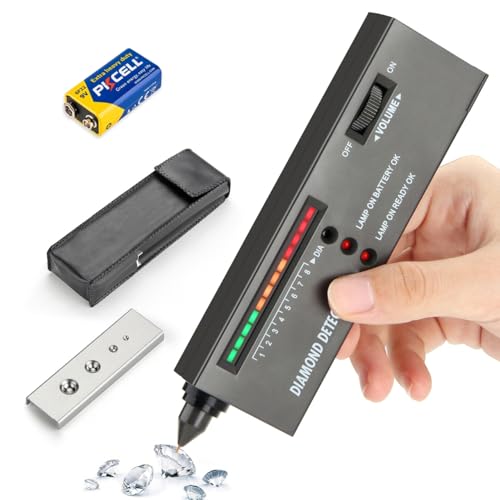
The Siziviki Diamond Tester Pen is a handheld gemstone detector for basic jewelry screening. It is designed to distinguish diamonds and moissanite from jade, crystal, and glass by combining indicator lights with audible beeps. Diamond or moissanite readings trigger nine or more lights, while jade shows five to six and crystal or glass shows five to seven. At around $10, it offers a low-cost option for checking loose stones or mounted jewelry.
This tester requires careful setup. Insert the included 9V battery with the correct polarity, power it on, and let it preheat for 30 seconds. The indicator must be adjusted to the fourth mark before testing, then reset there before each new stone. Hold the rear metal plate and place the probe at a 90-degree angle to the gem. A testing platform, printed manual, and video guide come in the package. Use it indoors at roughly 15 to 25°C for more consistent readings.
Pros
- Includes a 9V battery and testing platform, so basic checks need few extra supplies.
- Uses different light and beep patterns for diamonds, moissanite, jade, crystal, and glass.
- The manual and video explain calibration, probe placement, and common operating errors.
Cons
- It cannot test gold or other metals, which may trigger beeps because their heat transfer resembles diamond.
- Results depend heavily on a 30-second warm-up, fourth-mark calibration, proper angle, and suitable room temperature.
3. HMKIS Diamond Tester Pen

Best for: Quick home jewelry checks
The HMKIS Diamond Tester Pen is a compact screening tool for diamonds and common lookalikes such as glass, crystal, and cubic zirconia. It uses an LCD, LED indicator, sound alerts, and separate large and small diamond settings. Before testing, you must select the correct size and touch the rear panel. The package includes a testing platform, user manual, and 1-meter USB-C cable.
A useful detail is the choice between USB-C power and a 9V battery. USB-C should provide steadier power, but this unit is non-rechargeable, so the cable powers the tester rather than charging it. Around $17, it also includes a 60X LED jeweler’s loupe with batteries. That magnifier can help inspect facets, scratches, settings, coins, and small markings. The tester is best viewed as a quick screening device, not a lab-grade appraisal tool. Metal, skin, water, and poor probe contact can trigger errors or shut the pen off.
Pros
- USB-C and 9V power options suit home or portable use.
- LCD, lights, and beeps make readings easier to follow.
- Included 60X LED loupe adds close-up inspection value.
Cons
- It requires manual size selection and rear-panel contact.
- It cannot provide a professional gemological certification.
2. Diamond Selector II Diamond Tester
Best for: Casual jewelry checks at home
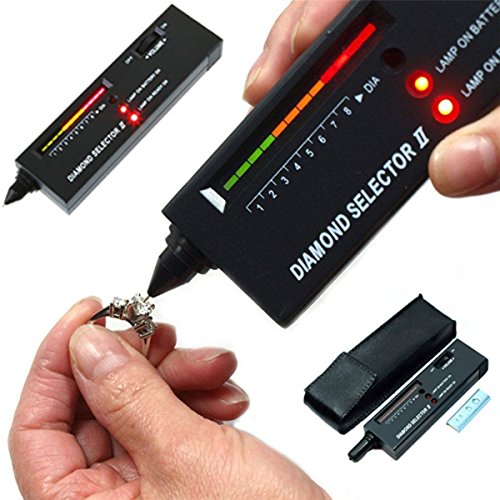
This handheld diamond tester uses thermal conductivity to separate diamonds from many imitations, such as cubic zirconia and crystal. It has an LCD display, LED indicators, and beeps to make readings easier to follow. The pen runs on one included 9V battery, and the package includes a leather pouch, testing platform, and user manual. At around $15, it costs far less than professional gem-testing equipment.
The setup requires more care than the simple pen shape suggests. Hold the tester in one hand while your other hand holds the stone. Your finger must touch the conductive panel on the back, and gloves can prevent the metal alert from working. At room temperature, the default setting uses four illuminated lights, but the manual provides adjustments for stone size and temperature. Use it between 10 and 35 degrees Celsius, below 80% humidity, and away from wind. Metal may trigger a high-frequency sound because it also conducts heat well, so the result is not proof of diamond authenticity.
Pros
- Includes the tester, leather case, testing platform, manual, and 9V battery.
- LCD, lights, and audible signals provide several reading cues.
- Compact pen design supports quick checks of loose stones or jewelry.
Cons
- Requires bare-hand, two-handed operation and finger contact with the rear panel.
- Metal can produce a diamond-like alert, so it cannot confirm a stone’s identity by itself.
1. Presidium Instruments Gem Tester II
Best for: Jewelry buyers needing quick gem checks
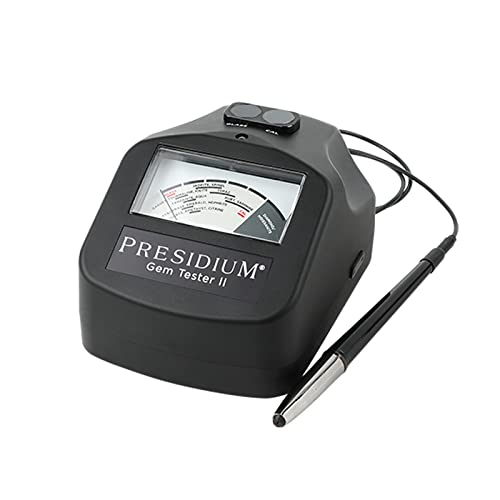
The Presidium Instruments Gem Tester II is a handheld tool for screening diamonds, moissanites, and common colored gemstones. Its analog dial gives a direct reading, while the retractable probe tip is designed to reach small stones and tight settings. The tester can differentiate up to 16 gemstone types, making it more useful than a diamond-only pen. At around $289, it targets jewelry buyers, appraisers, and repair shops that need a portable identification aid.
Assisted Thermal Calibration lets users recalibrate the unit for their testing environment instead of relying on a fixed setup. That matters because temperature can affect thermal readings. The redesigned body is more compact and sturdy than earlier versions, according to the product details, and the probe retracts for storage. Still, this is a screening device, not a full gemological identification system. It cannot replace a loupe, microscope, refractometer, or lab report when a stone’s value or origin matters. Calibration may also shift during shipping, so buyers should check the unit before use and contact the seller if readings seem inconsistent.
Pros
- Tests for both diamonds and moissanites, not just one stone type.
- Covers up to 16 gemstone categories with a readable analog dial.
- Assisted Thermal Calibration helps adjust readings to the local testing environment.
Cons
- Calibration can be affected during shipping and may require seller support.
- It provides screening results, not the complete analysis of a professional gem laboratory.
Buying Guide
The most important factor is accurate separation of diamond, moissanite, and common simulants. A reliable tester should use thermal and electrical readings, since heat-only models can mistake moissanite for diamond.
-
Testing method: Choose a dual thermal and electrical tester for loose stones and mounted jewelry. Thermal-only pens are less useful because moissanite can produce a diamond-like heat reading.
-
Accuracy and limits: Look for published accuracy near 95% or higher, but treat that figure as a screening claim. No handheld tester can prove a diamond is natural, untreated, or mined.
-
Stone size range: Confirm the device handles stones from about 0.02 to 10 carats if you inspect mixed jewelry. Some compact pens work best on stones above 0.05 carat.
-
Power and display: Prefer a model with a low-battery warning, automatic shutoff, and at least 8 hours of stated use per charge. Audible alerts and separate diamond, moissanite, and simulant indicators speed up sorting.
-
Price and support: Basic thermal pens often cost $20 to $60, while combination testers commonly range from $100 to $500. Check for a 1-year warranty, calibration instructions, and included probe tips.
If you cannot have everything, prioritize a dual-sensor tester with clear moissanite detection.
Frequently Asked Questions
How do diamond detector machines work?
Diamond detector machines usually identify diamonds by measuring how quickly a stone carries heat, though some models also check electrical conductivity. A thermal probe may separate diamond from glass or cubic zirconia, but moissanite can trigger a false positive on basic testers.
What should I look for in a diamond testing device?
Look for a tester with clear diamond and moissanite warnings, a replaceable tip, stable calibration, and an easy-to-read result. Battery type also matters: a 9-volt model may suit occasional checks, while rechargeable units reduce the cost of regular use over time.
Can a diamond detector tell real diamonds from fake stones?
A diamond detector can separate many imitations from diamond, but it cannot confirm authenticity on its own. Basic thermal pens may read moissanite as diamond, and they cannot identify treatments, lab-grown origin, or a mounted stone’s full history with certainty.
Are expensive diamond testers more accurate than cheap ones?
More expensive diamond testers are not automatically more accurate, but they often add moissanite detection, calibration controls, and stronger probes. A $20 thermal pen may offer a quick screening result, while a professional meter can provide separate readings for thermal and electrical conductivity.
Conclusion
The Presidium Instruments Gem Tester II is the top recommendation for jewelry buyers, hobbyists, and small shop owners who want a compact tool for basic gemstone screening. If your priority is testing many stones quickly, pick a larger professional unit with a wider probe range, clearer display, and better workflow for repeated checks. Before buying, double-check the tester’s size, included accessories, compatibility with the stones and settings you plan to examine, package quantity, and current price. Remember that electronic screening supports a buying decision, but it does not replace a trained gemologist’s identification or a laboratory report. For valuable diamonds, use the device as one checkpoint, then request independent verification before paying.